





by Kyle Buchter
Trail Boss
What size winch do you need? That is a question many ask when they see all the different capacity choices on the market. And the eye always seems to skew towards the larger versions.
But can you go too big with a winch choice? Yes, and here is why.
We have heard it many times; “put as big of a winch as you can afford on your Jeep.” And while that may seem like good advice, and there are numerous reasons why people say that, here is a more realistic view.
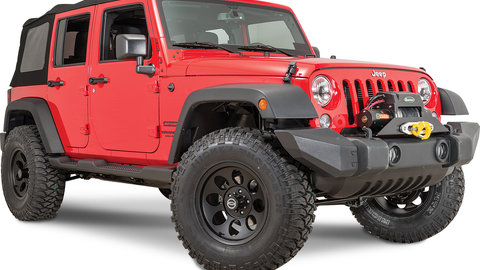
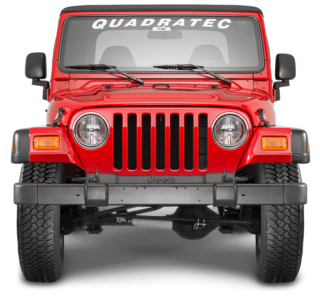
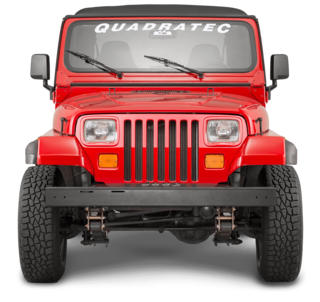
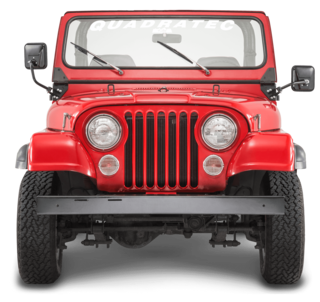
A Wrangler TJ is a great example. This vehicle weighs approximately 3,500-4,500 pounds and pre-2007 Jeeps (CJ, YJ, XJ, ZJ, TJ) utilized the 1.5 x Gross Vehicle Weight (GVW) formula for determining the required winch capacity.
This generally meant an 8,000-9,500 pound capacity winch would be plenty to serve any recovery need. So, if that is the standard, wouldn’t a 12,000 lb. winch be that much better?
Not really.
If you put a 12,000 lb. winch on that Wrangler TJ it could cause major problems. Why? Because the frame, bumper, bolts and mounting systems are not designed to withstand those forces.
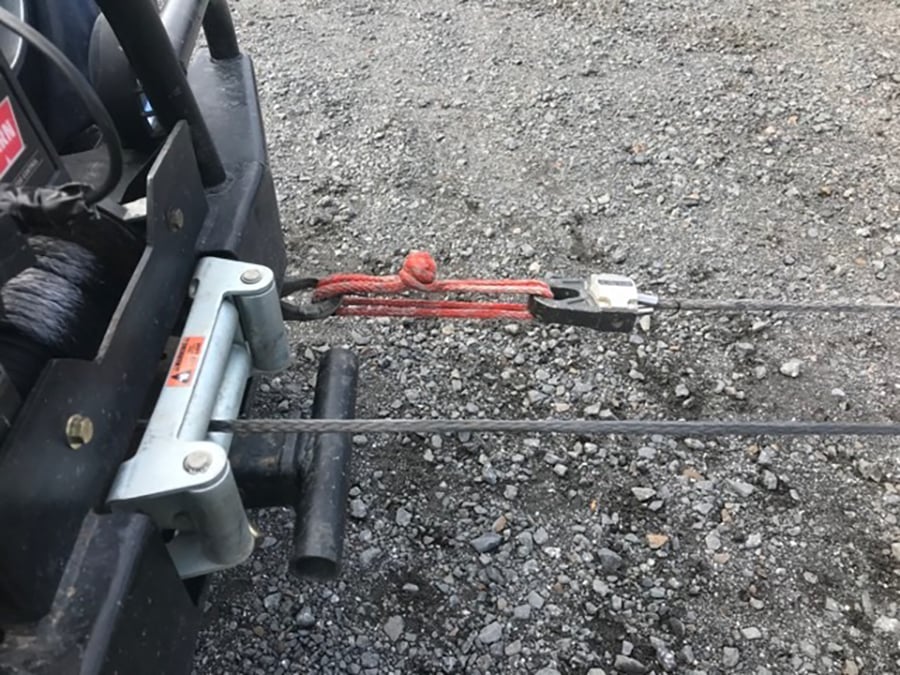
In a single line pull configuration, the vehicle will see up to 12,000 pounds of force which is 6,000 pounds per frame rail. The frame can handle those forces. Now, a double line pull with max line out and on the last wrap of the drum — this can apply almost 24,000 pounds of force on the frame and mounting points. That could be 6,000 pounds on one frame rail and 18,000 pounds on the other.
Which can lead to vehicle damage due to pulling forces.
The frame rails on those Wrangler TJ vehicles are not designed for that much of a load. Bumpers can bend and frame rails can be damaged.

There are also concerns with the vehicle’s suspension. If the Wrangler TJ is mired to the frame in mud and a double line pull (or more) is used, issues could occur. Stresses that will be applied to the suspension can damage components and the mounts. Sometimes the body will move and the axles will not. The forces on these connections are too great. Additionally, the use of two, and sometimes three, snatch/pulley blocks will eventually find that weakest link.
Some industry examples show that rigging four to five times the pulling capacity of the winch is good practice, but in reality it could severely damage that vehicle.
Can you get away with this? You may know how to use your winch but if you do not understand semi-complex rigging then there could be issues. This means knowing your winch's capacity, pull by layers, being able to manipulate the situation to control the pulling forces and more.

With the Wrangler JK, JL and Gladiator JT, winch best practice is to use something sized at two times the weight of the vehicle (2 x GVW). If you are not sure of your Jeep’s GVW, look at your vehicle data information on the driver’s side door area of the vehicle.
With all of the 10-20,000 lb. winches out there, you can certainly find something that will be more than you need. But finding the right recovery gear for your needs, and vehicle, is important. With the right rigging equipment (winch accessory kit), a smaller capacity winch can do the job, and will allow you to configure the loads where they can be spread out. This will lessen the loads on the connection points and still provide the same pulling forces needed.