
















by Quadratec
For much of the last several years, Jeep’s future has sounded like a corporate PowerPoint presentation.
Electrification targets. Software platforms. Global architectures. Efficiency goals.
Important stuff, certainly. But not exactly the kind of language that gets Wrangler owners arguing excitedly around campfires or flooding forums at two in the morning.
Now, though, Jeep suddenly appears ready to get wild again.
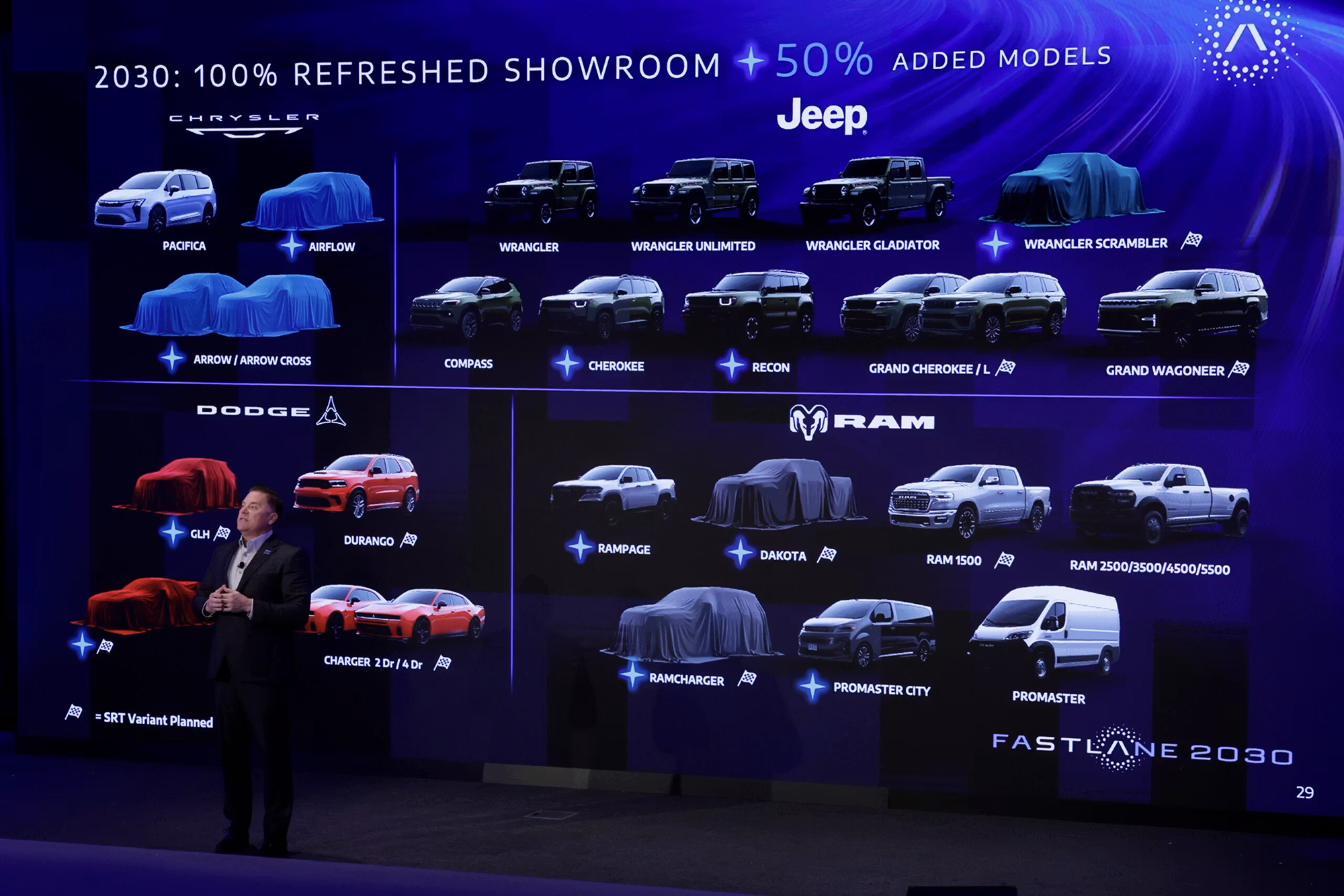
According to multiple reports emerging from Stellantis’ recent Investor Day presentation and subsequent supplier discussions, the automaker is developing a new two-door Wrangler-based pickup truck that would revive a familiar nameplate while potentially serving as a new halo vehicle for the brand’s off-road lineup.
And that name is Scrambler.
The reveal was part of Stellantis’ recent announcement that it plans to invest $70 billion into an aggressive turnaround strategy to bring 60 new vehicles to market through 2030.
Besides Scrambler, the brand’s latest offering, Recon, was also mentioned during Thursday’s announcement. Since its reveal last year, the Recon had been touted as an all-electric Wrangler alternative, but with many in the industry moving away from electrification, Stellantis said it will now offer the Recon an internal combustion engine option for the North American market.
The original Jeep Scrambler, officially sold as the CJ-8 between 1981 and 1986, occupied a unique space in Jeep history.
Long before lifestyle pickups became mainstream, the Scrambler fused compact truck utility with removable tops, off-road capability, and unmistakable Jeep character. Production numbers remained relatively low during its original run, but the model gradually evolved into one of the most sought-after and collectible Jeeps ever produced.
Now, nearly four decades later, Jeep looks ready to resurrect the nameplate in a dramatically different form.
Jeep Wrangler Scrambler Details
Reports from Investor’s Day indicate the upcoming Scrambler project as a flagship off-road product sitting above today’s Gladiator lineup. Stellantis Design chief Ralph Gilles reportedly described the concept as combining elements of a trophy truck, Wrangler, and even a minivan from a packaging standpoint. While unconventional on paper, the description hints at Jeep pursuing a more radical interpretation of an off-road pickup.
Perhaps the most significant engineering detail involves suspension architecture.
Unlike the Wrangler’s traditional solid-axle setup, the new Scrambler reportedly may adopt independent front and rear suspension, marking one of the most substantial departures from Wrangler mechanical tradition in modern Jeep history.
Such a move would suggest Jeep intends the vehicle to excel not only in low-speed rock crawling, but also in higher-speed desert running and performance-oriented off-road driving, areas where independent suspension systems typically provide substantial advantages.
If accurate, the strategy would place the Scrambler into direct philosophical competition with vehicles like the Ford F-150 Raptor and other factory-engineered off-road performance trucks.
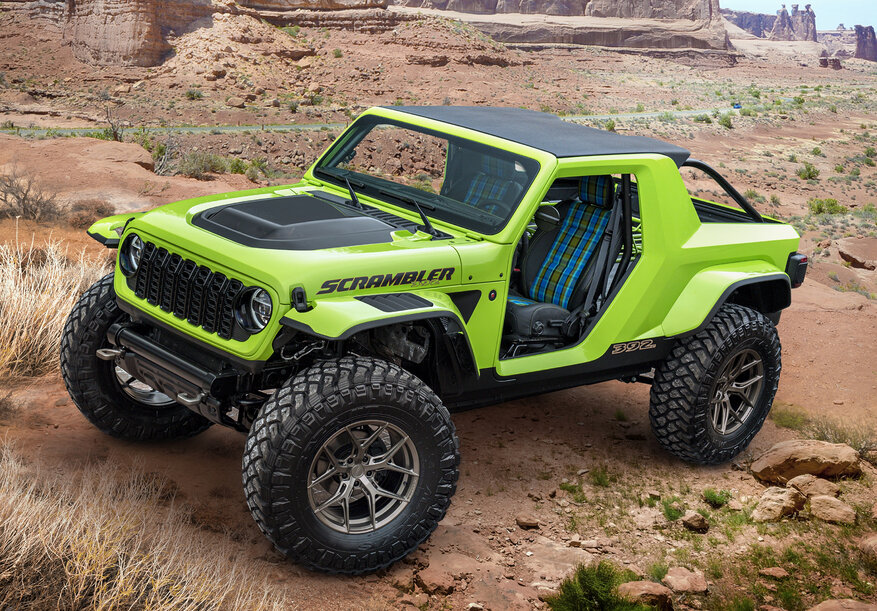
Jeep did roll out a Scrambler 392 concept vehicle back in 2023 during the annual Easter Jeep Safari in Moab, Utah. That one took a Wrangler Unlimited platform, sculpted out the rear doors, turned the cargo area into a ‘truck-ish’ bed, and added a bunch of custom carbon-fiber bodywork to lighten the vehicle. Designers also stuffed a 6.4-liter Hemi V8 under the hood for an impressive 470 horsepower and 470 lb-ft of torque, while laying back the windshield 12 degrees in a nod to older ‘chopped’ hot rods.
That may be a bit much to expect from a production Scrambler, but a grille similar to the recent EJS Anvil concept could be an option, as well as different windshield dynamics and either the new 3.0-liter Hurricane engine or the 6.4-liter V8 Hemi.
The Scrambler itself may only be part of a broader Jeep performance renaissance.
Additional reports tied to Stellantis’ future product roadmap indicate Jeep plans to reintroduce SRT variants across several key models, including the Grand Cherokee and Grand Wagoneer, which represents a notable shift in tone.
Over the past several years, uncertainty surrounding HEMI V-8 production, tightening emissions regulations, and Stellantis’ heavy public focus on electrification led many to question whether Jeep’s performance-oriented identity would gradually fade away.
Instead, this latest information suggests the company is looking to reboot its strategy to preserve enthusiast-focused internal combustion products alongside expanding electrified offerings.
The continued popularity of the Wrangler 392 likely plays a major role in that thinking.
Since its debut, the V-8-powered Wrangler has become one of Jeep’s most celebrated enthusiast products in recent memory, demonstrating that demand for high-performance off-road vehicles remains exceptionally strong despite broader industry trends.
As far as the Recon, it was originally introduced as an all-electric off-road SUV positioned alongside the Wrangler, and expected to serve as one of Jeep’s flagship EV entries as the brand accelerated toward electrification.
However, the swap to an ICE powerplant suggests Stellantis may be softening its previously aggressive EV-only messaging in favor of a more flexible multi-powertrain strategy, particularly for brands like Jeep whose customer base remains deeply tied to long-distance travel, off-grid capability, and mechanical durability.
Problems with its popular, but flawed Wrangler 4xe, certainly played a role in this shift, but market preferences surely did as well.
In practical terms, Jeep appears increasingly interested in offering electrification as an expansion of the lineup rather than a complete replacement for traditional combustion vehicles.
For many core Jeep buyers, that distinction matters considerably.
Rather than focusing exclusively on efficiency mandates or crossover expansion, Jeep appears increasingly committed to reinforcing the qualities that historically defined the brand:
- Open-air freedom
- Off-road capability
- Performance
- Distinctive design
- Emotional appeal
Jeep has not publicly detailed final production timelines, powertrains, pricing, or engineering specifications for the Scrambler project. Likewise, several elements surrounding future SRT models and the Recon lineup remain fluid as Stellantis continues refining its long-term product strategy.
Still, the broader direction now coming into focus is difficult to ignore.
After several years dominated by corporate electrification messaging, Jeep suddenly appears poised to re-embrace bold, enthusiast-oriented product development in a way that feels unmistakably aligned with the brand’s heritage.
Related Jeep Guides, Tips & Trail Advice:
Jeep Death Wobble Q&A: Causes, Symptoms, Fixes and How to Prevent It
Jeep Unveils Wrangler America250 Edition With Patriotic Styling and Captain America Collaboration