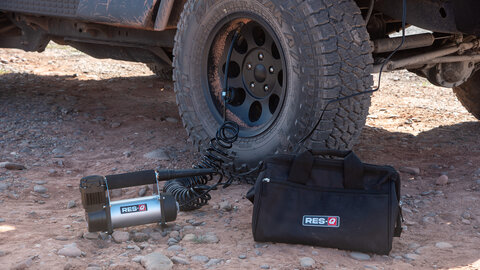














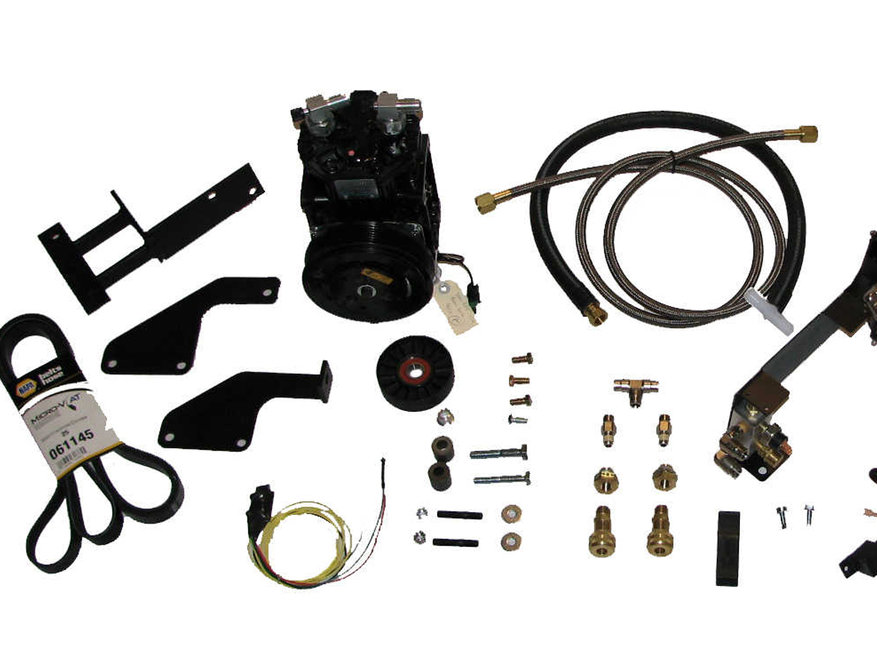
One question that is frequently asked by our customers is "Which parts do I need for my On-Board Air (OBA) installation?" Seems like a simple question. But there are many variables to an OBA system. Most folks simply want a way to get air into their tires. Yet others want to run air lockers in addition to airing up tires. And many folks out there want to be able to run air tools. While many of our customers want to buy everything they'll need from us, there are still many who want to use components they already have available. And if that isn't enough, we can't even begin to speculate all the different places OBA components have been mounted on the vehicle. It is difficult for us at OBA to foresee how you plan to install and use your OBA system. For these reasons, we hesitate to recommend *exactly* what each individual needs here on a web site without writing volumes. The specific details of each OBA system must be left up to you, the customer, to decide what is best for your needs.
All that said, we can't resist taking a shot at a general recommendation. Besides the install kit, compressor and matching clutch, here is a brief list of what OBA would generally recommend for a complete OBA system. Keep in mind, you'll still need to decide which air tank best suits your needs and which brass fittings you'll need to complete the install. Check out all of our OBA systems here
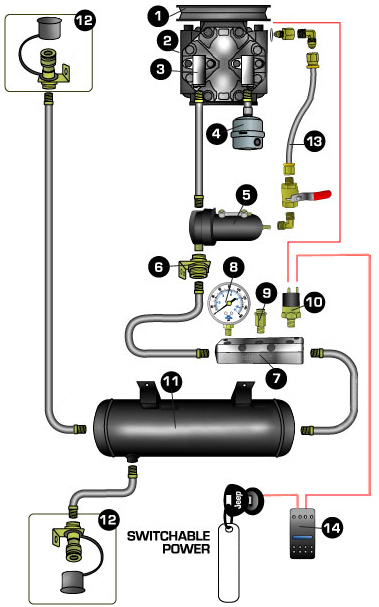
| ITEM # |
ITEM DESCRIPTION |
ITEM USE |
| 1 | Compressor Clutch |
Engages and disengages the compressor
|
| 2 |
Compressor
|
Compresses air to form pressure to fill the tank
|
| 3 |
Compressor Fittings
|
Connects the lines to the compressor
|
| 4 |
Intake Filter
|
Makes sure your compressor only runs on clean air.
|
| 5 | Coalescing Filter |
Removes oil from the air coming out of the compressor
|
| 6 |
Check Valve
|
One way valve. Not needed if your not running an air tank |
| 7 |
Air Manifold
|
A union to place the safety valve, gauge, and pressure switch
|
| 8 |
A Gauge
|
Allows you to see how much pressure is being generated
|
| 9 |
Safety Valve (Pressure relief valve)
|
A cheap safety device in case of pressure switch failure
|
| 10 |
Pressure Switch
|
Determines the minimum and maximum pressure the system operates at
|
| 11 | Air Tank | Allows a volume of compressed air to be stored for use such as in air tools or for filling tires. Gives a head start to not work the compressor so hard |
| 12 | Air Couplers | Allows the connection of accessories to the system such as air tools or tire chucks |
| 13 | Oil Return Kit | Routes oil from the filter back to the compressor for reuse |
| 14 | ON/OFF Switch | Determines when the clutch is powered to engage or disengage the clutch |
What type of oil should I use and how much?
Typical engine oil such as 10w30 will work fine. Run 8-10 ounces.
I see you lay the compressor down in some applications. Is that ok? Will it pump more oil out if I lay mine down?
If it wasn't ok, we wouldn't do it. When laying the compressor on it's side, you have to make sure the suction port is on top. It will not pump any more oil if laying down versus standing up.
How can I tell if mine is a right or left hand suction?
Stand the compressor up with the clutch facing your stomach. You'll have one fitting on the right and one on the left. The head should be marked with a "S" or "Suct" for suction and "D" or "Disch" for discharge.
If my compressor is standing up, does it matter if I use a left or right hand suction compressor?
No, it doesn't matter. However we stock a lot more right hand suction compressors than the left hand units so we'll probably ship you a right hand suction unit.
What type of fittings do I need for my compressor?
Flange head compressors use the 28723 fittings, Rotolock and Tube-O compressors use the 44760 fittings.
Do I need a check valve?
No. This is an option. However, we do recommend the use of one if you're running an air tank. The compressor will leak some air when it's not running and the check valve will keep the pressure in the tank.
I've heard I need an unloader on my system. Is this correct? What is an unloader?
With engine driven compressors, you do not need the unloader. When equipped, the unloader will release the air pressure between the compressor and check valve. This is more commonly found on electric compressors that need help when starting up from a dead stop. By releasing the air pressure off the head of the compressor, the electric motor can spin up more quickly and easily, which requires less amperage on start up. On engine driven systems, your engine is already running. All you need to do is engage the clutch. Have you ever seen an air conditioning system with an unloader? No. If you did, it wouldn't have any freon left!
What is a safety valve? Do I need one?
If you ask me you do. It's a safety device designed to release the air pressure in your system very quickly in case the pressure switch fails to shut off. We offer one that is
adjustable so you can set it's "pop off" pressure where you need it.
What pressure should I set my safety valve at?
10-15 lbs above the cut off pressure of the pressure switch should be fine. You'll need to bypass the pressure switch to set the safety valve.