









Based on all the press lately, you may think diesel engines are a terrible thing; existing just to get their parent automakers in trouble with various government organizations like the EPA.
But beyond all the hullabaloo and allegations about defeat devices, improper notification and emissions testing, these engines are serious works of art for those who love taking their vehicles off pavement.
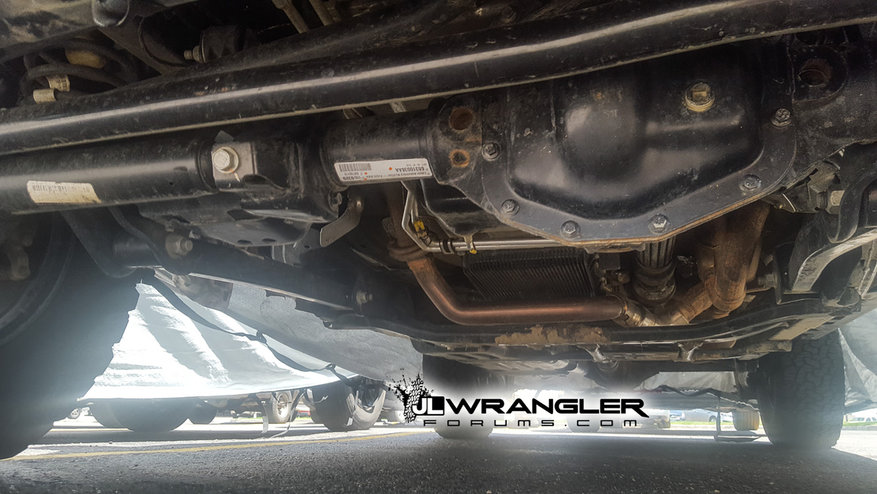
So when the folks over at JL Wrangler Forums let it be known that, not only was Jeep physically testing out a 3.0L diesel engine for its upcoming Wrangler JL redesign, but a photographer actually crawled under the test mule and snapped some pictures, well, people stood up and took notice.
You can see their overall picture gallery here.
Now, granted, this isn’t exactly ‘pull down the curtain’ shocking news. We’ve heard for a while now that Fiat Chrysler Automobiles was planning on placing a diesel engine inside their new Wrangler. Hearing, though, is one thing. Seeing is another. And while it is a long way from the 2019 model year, it certainly appears FCA is heading in a diesel direction that many Wrangler owners have wanted for a long time.
It only makes sense as diesel offers quite a bit for the off road crowd. Now, no one is arguing that gas-powered engines are terrible when you hit the trail. Most of us have one in our rigs and do just fine, but diesel engines do check off boxes that gas ones can’t touch. Many of you might know already, but here are a few.
First – better mileage. Diesel vehicles simply go further on a tank. And when you are on that long trail run with no Gerry cans to help, that extra fuel economy does provide peace of mind. Plus, diesel fuel can be safer than gasoline thanks to its lower volatility. When refueling on a run, or perhaps at base camp on a multi-day trek, there is way less risk of that fuel vapor catching fire when accidentally fueling close to a heat source.
Next – water. How many trail runs have you been on when you barrel through a water crossing hoping for the best? In truth, a well-prepared gas engine can take on this challenge, but most are not totally set up for a deep water crossing. Diesel engines can be much more beneficial and one just needs something to help keep water away from the air intake and the thing can all but go underwater.
Third – torque. The big T. Diesel engines may not have much on gas in the horsepower department, but their low-end torque rating is normally tremendous. What this means for the off road types is more power at low rpms to easily attack obstacles without fear of stalling or having to maintain high revs for success. It also provides additional benefits when towing or hauling heavy items.
There are some drawbacks to diesel though. Nothing is perfect. The engines are heavier than their gas counterparts, on average about 10 to 20 percent heavier. Plus, they are more expensive so that 2019 diesel Wrangler will most likely be somewhere around $3,000-5,000 more expensive than the 3.6L Pentastar version.
However, to offset that, diesel engines are generally longer lasting and will require less maintenance – save for a more rigid oil change schedule over its lifespan.
Of course, all this is dependent on FCA gaining EPA certification on the new diesel engines. The automaker currently has submitted an application for certification, but is still in pending litigation for other past diesel engines which the EPA says contained improper software or defeat devices designed to cheat emissions testing.
FCA has denied the company’s diesel engines have any kind of illegal software or defeat devices, noting they have cooperated with federal regulators since the investigation was launched.
As far as any specs on the 2019 diesel, with the vehicle still in the testing stage there is no word yet from FCA on what type of power specs we can expect. However, as a barometer, the current Grand Cherokee’s 3.0L V6 EcoDiesel pushes out 240 hp and an ample 420 lb-ft of torque at a low 2000 rpm. In contrast, the current Wrangler’s 3.6L Pentastar gas engine stands at slightly more horsepower with 285, but much less torque at 4800 rpm with 260 lt-ft.
Keep in mind, this engine will not hit the ground running with the 2018 Jeep Wrangler JL which is due out later this year. The first-year edition of Wrangler's redesign will only come complete with the gasoline 3.6L Pentastar and a 2.0L Hurricane Turbo.