







by Kyle Buchter
Quadratec Channel Correspondent
The time has come and you are ready to replace your Jeep’s driveshaft. Perhaps you have recently lifted your vehicle, or you are looking for a stronger driveshaft - maybe you dented it on your last four-wheeling trip. These are all reasons why folks upgrade their driveshafts.
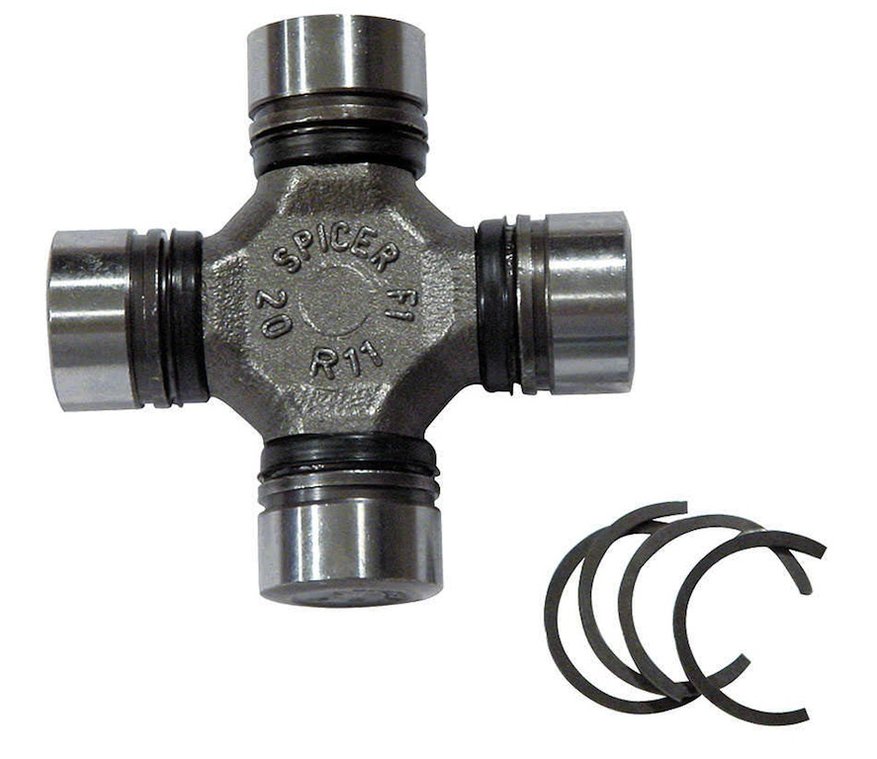
But what U-joint should you go with? And what, exactly, is the job of a U-joint? Well, a U-joint is designed to not only allow the driveshaft to move in it's arc without binding, but it is also the weak link. Weak! What? I can't have anything weak on my Jeep! Roar!!! Now, now, hold your horses out there and keep reading.
Most likely your Jeep came factory with a 1310 or 1330 U-joint in your driveshaft. Right away, most folks listen to that little voice saying ‘Bigger is always better’. But before you listen to that voice, take a few things into consideration.
You may think, if your jeep came with 1310 or 1330 U-joint, the next step would be to upgrade to a 1350 U-joint – it is heavier duty and the number is larger than 1310, so it must be the way to go, right?
Of course a 1350 u-joint is going to be stronger, but think about this:
You are out on the trails at your favorite off road park in your JK and have the following set up: 3" inch lift, 35” tires and stock axles. You have found your way over to a trail called ‘Axle Crusher’. Sounds fun! Your suspension is articulating, axles and transfer case are transferring power, your driveshaft is working and the 1310 u-joints are binding up. You are feeling awesome! And then, SNAP!!
Your 1310 U-joint has broken! Guess what? That is ok!
Your Jeep is composed of many components; many expensive and time consuming components when it come to repairs. However, that 1310 U-joint only costs about $15 to replace, and if you have any mechanical skills you can change it while out on the trails.
The 1310 U-joints are typically easier to find when you need a new one as most auto parts stores have them in stock, and when you go off-roading and happen to break a driveshaft or joint, your buddies with similar vehicles will usually have the factory replacement spare.
So why is it okay that your 1310's broke, other than they are readily available?
You see, the 1310's are your vehicle’s weakest link. Not the W word! I am a off-road warrior! I must upgrade!
Take a deep breath, stop beating your chest, and consider this:
When your Jeep was working that hard trail, everything was experiencing stress - your axle, driveshaft, etc. But the weakest link, aka that 1310 U-joint, takes the hit and breaks before your axle or your transfer case. Lets face it, would you rather replace a $15 part and have your vehicle back on the road or trail in a timely fashion, or would you rather spend $1,000 to have your axle rebuilt? Now, let’s be clear on one thing, this doesn't mean that U-joint will always fail, it just means it is the stress point.
Okay, so what about the 1350 U-joint? They are bigger and stronger but that means unless you have the set up to accommodate this kind of strength, you may do more harm than good.
Take the same situation from above, on Axle Crusher trail, you and your JK lifted with 35s and stock axles, but instead you went with the ‘bigger is better’ voice and have 1350 U-joints. The vehicle is working like it did before, but this time it isn't the 1350 U-joint that breaks - it is your stock axle or ring and pinion. Why? The 1350 U-joint is strong enough that it is no longer your vehicle’s weakest link. Now, your axle or transfer case is the weakest link. And now you are on the trails with a broken axle instead of a broken 1310 U-joint which you could have repaired right there for under $20. Make sense?
This might be a big pill to swallow, but sometimes bigger is not always better. Say it with me. Bigger is not always better.
If you are still running factory axles or even a slightly stronger upgrade, then staying with the factory-sized 1310 or 1330 U-joint will keep your weakest link at a $15 part replacement vs. that $1000 wallet-sapping repair.
So who should consider upgrading to 1350 U-joints?
Well, if your vehicle is heavily modified, sporting Dana 60 axles, 40” tires, and you find your time outside is usually spent around boulder infested black or red trails, then you may want to consider 1350 U-joints. How come? Because those other components on your Jeep - axles, tires, etc. - are stronger than 1350s, so the U-joints then become your weakest link.
Back to the trails, with your JK on 42's, Dana 60s and 1350 U-joints, and your group decides to take on a trail called "Death Trap" (Scary!)
Your axles are working, transfer case is sending power and your heart is racing! Then SNAP! The 1350 u joints have met their match, but you are perfectly happy to replace the $15.00 part rather than your $2500 Dana 60.
The downside to using 1350s is they are not as readily available vs. the 1310s. If all of your wheeling buddies have 1310s, you may have limited options so you might want to carry a few spare 1350 U-joints just in case.
So which is better? 1310s or 1350s?
There are hundreds of vehicle set ups and factors that you should consider when deciding 1310s vs 1350s.
Good rule of thumb - if you are on a 37” tire or under, stay with the 1310s. If you are running stock or slightly upgraded axles, stay with the 1310s. You want that U-joint as your weakest link.
If you are running 40s with a Dana 60 axle or larger, then 1350s are a great choice and will become your weakest link. Woo hoo for the weakest link!
Having a 1310 U-joint is not a bad thing and it is not something to be embarrassed about. Consider your set up and off-roading goals.
What about if you are constantly breaking your 1310 U-joints, though?
Well, before you upgrade to the 1350s you should examine your drive line setup. Is everything lined up correctly? Is something out of sorts that is causing the U-joints to have unnecessary pressure?
Also, evaluate your driving skills and trail selection - if you are wheeling hard trails with stock axles and 32s, then those trails are most likely going to be eating your 1310 U-joints for breakfast. If you are okay with that, then fine. At least they aren't eating your axles.
Maybe you should upgrade to a slightly larger lift/tire combination though, or even upgrading the axle if you really want to go wheeling on those hard, intense trails.
Just always remember, it is okay to have a weak point - in fact you must have a weak point! It is up to you to decide what that weak point is, your $1000 axle or $15 U-joint.
Be proud of that weakest link!