










by Matthew Konkle
Executive Editor
There is a distinct, heart-in-your-throat moment every off-roader knows too well when approaching a murky water crossing out on the trail. You peer over the hood as you enter, try to gauge the depth, and quickly realize the water line is creeping dangerously close to your headlights. Even worse, it's now sitting dead-level with your factory air box.
That is precisely when every driver wishes they had a reliable way to keep their engine breathing while the rest of the truck is submerged.
Something reliable like a Jeep snorkel.
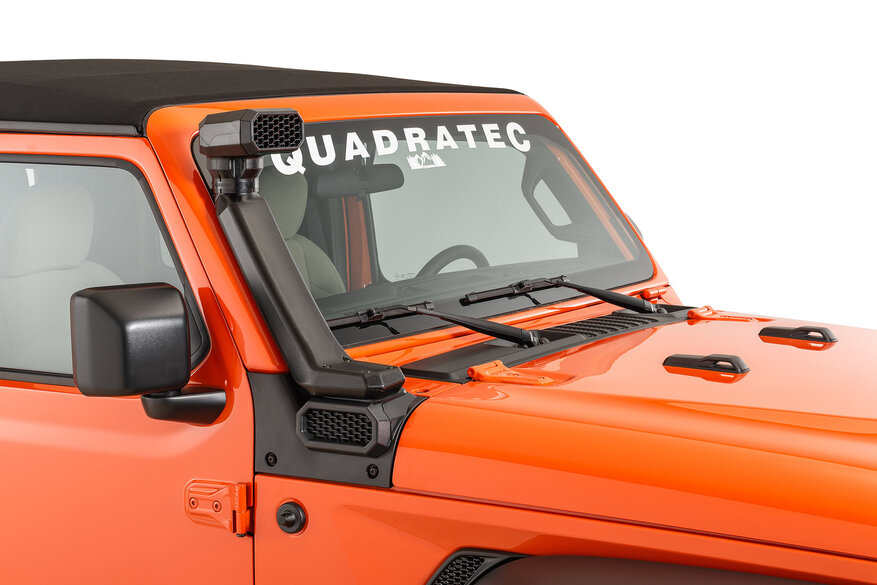
For the uninitiated, a Jeep snorkel looks like an aggressive, high-mounted intake running up the passenger-side (sometimes driver-side) A-pillar, giving the vehicle an immediate expedition-ready aesthetic. But to anyone who lives the Jeep lifestyle and pushes their rig off the beaten path, it is more than a cosmetic badge of honor. It is vital mechanical insurance for your engine.
Whether you are building an overlanding Jeep for cross-country exploration or prepping for severe trail hazards, understanding what a snorkel does and how it transforms your Jeep's capabilities is essential.
What Exactly Is a Jeep Snorkel?
At its core, a Jeep snorkel (more accurately known as a raised air intake) is a closed duct system that relocates your engine's intake point from inside the low-slung, vulnerable environment of the engine bay up to the roofline or upper windshield level.
Instead of pulling air from behind the passenger-side (or driver-side) inner fender liner, where a deep puddle, hidden rut, or sudden river crossing can easily submerge that liner, a snorkel draws clean, high-altitude air through a rigid, sealed polymer or rotationally molded polyethylene duct system connected directly to your factory or aftermarket airbox.
The Ultimate Engine Insurance: Hydro-Lock Prevention
The primary and most critical reason to bolt a snorkel onto your Wrangler or Gladiator is to save the engine from locking up due to excessive moisture.
Internal combustion engines rely on a precise, continuous cycle of compressing air and fuel inside the cylinders to create power. Air is compressible; water is not. If your factory air intake dips below the surface of water, deep mud, or a churning river crossing, the engine will instantly vacuum liquid straight into the intake tract.
When that happens, the pistons try to compress an incompressible fluid, resulting in catastrophic engine failure: bent connecting rods, cracked engine blocks, sheared valves, and an astronomically expensive repair bill. By raising the intake opening several feet into the air, a snorkel allows you to safely navigate deep water crossings up to the safe operating limits of your vehicle's door seals, electronics, and differential breathers.
How much does that actually buy you? For context, Jeep rates the stock Wrangler JL at a factory water fording depth of 30 inches at speeds under 5 mph, measured to the bottom of the front fascia, not the top of the intake, assuming a firm, hard-bottomed crossing. A snorkel moves your intake's actual submersion point well above that number, but it's important to understand what it does and doesn't change, as the intake is only one vulnerable point on the vehicle.
Beyond the Intake: What Else Needs to Be Water-Ready
This is the detail that catches a lot of first-time snorkel buyers off guard: bolting on a snorkel does not, by itself, turn your Jeep into a submarine.
Your differentials, transfer case, and transmission all rely on small breather tubes to vent pressure as internal components heat up and cool down. If those breather tubes end up submerged during a crossing, the same pressure differential that's supposed to vent air can instead pull water directly into your gear oil, silently contaminating your axles and transmission long after you've dried off. Many serious wheelers pair a snorkel install with extended breather hoses, routing them up near the snorkel or into the engine bay, specifically to close this gap.
It's also worth giving your electrical connections, especially anything near the frame rails, starter, and alternator, a once-over with dielectric grease before any serious water crossing. A snorkel protects your engine's ability to breathe; it doesn't protect everything else that can be affected by submersion.
The Hidden Trail Benefit: Cleaner Air and Reduced Dust
While dramatic water crossings get all the glory in promotional videos, experienced wheelers know that a snorkel is also an important addition in bone-dry, dusty environments.
When you are in a convoy through heavy desert silt, loose sand, or dry summer dirt roads, the vehicle directly ahead of you kicks up a massive, rolling plume of particulate matter and fine dust. Because your factory intake sits low in the fender well, it acts like an industrial vacuum cleaner for airborne dirt, rapidly clogging your air filter and starving your engine of oxygen.
By relocating the intake high up into cleaner, less turbulent atmospheric air, a snorkel drastically extends your air filter's operational lifespan. Many modern off-road snorkels also feature interchangeable tops—allowing you to swap a standard ram-air head for a centrifugal pre-cleaner that spins out heavy dust and debris before it ever reaches the filter element.
Ram-Air Effect vs. Pre-Cleaners: Choosing the Right One
When outfitting your Jeep with a snorkel, the top configuration matters just as much as the duct routing:- Ram-Air Heads: Designed to capture forward-facing airflow as you cruise down the highway or trail, utilizing vehicle momentum to help force air into the intake tract.
- Cyclonic Pre-Cleaners: Utilizing internal vanes to create a spinning vortex, these drop heavy dust, sand, and moisture into a clear collection bowl, making them the gold standard for arid, desert overlanding.
- Low-Profile Caps: Sleek, low-clearance options designed for tight wooded trails where traditional high-mounted snorkel tops might catch low-hanging branches.
Materials & Build Quality: What to Know
Not all snorkels are built the same, and the material style can really matter.
Rotationally molded polyethylene is the industry standard for a reason. The process produces a single-piece, seamless duct with consistent wall thickness and no weak seams, which matters when the part's job is to keep water out under pressure. It's also naturally UV- and impact-resistant, which counts for a lot on a part that lives outside on the A-pillar year-round.
ABS plastic snorkels are typically lighter and less expensive but are more prone to UV fading and cracking over time, especially in harsh sun or cold climates. They're a reasonable choice for a daily-driven Jeep that only sees occasional trail use, but less ideal for a dedicated expedition build.
Most quality snorkels ship pre-primed and ready for paint, letting you color-match the body or run a contrasting finish, though the base material itself is typically some shade of black or gray from the factory.
Installation: What to Expect
This is one area where it pays to set expectations correctly before ordering.
A snorkel install may require cutting into the factory fender and/or hood to route the new intake duct and mount the snorkel body, along with rerouting or replacing sections of factory intake tubing under the hood. Most quality kits include a paper or vinyl cutting template to guide the fender modification, along with all new gaskets, clamps, and mounting hardware.
Realistically, budget a full weekend for a first-time DIY install, more if you're also painting the unit to match your Jeep. Because the job involves permanently cutting body panels, many owners less comfortable with fabrication opt to have it professionally installed rather than risk a misaligned cut. Once it's on, though, it's a one-and-done modification; there's no ongoing maintenance beyond occasionally checking the seals and periodically cleaning any debris out of the intake head.
A Note on Legality and Warranty
Because a snorkel relocates the intake but doesn't alter the emissions control system, engine tuning, or exhaust, it's generally treated differently than performance modifications like tunes or aftermarket exhaust systems from a compliance standpoint. That said, regulations and dealer policies can vary by state and by dealership, so it's worth confirming with your specific dealer how a snorkel install may be treated under your factory powertrain warranty, particularly if you ever need warranty work done on anything in the engine bay.
Do You Need One for Your Build?
If your weekend adventures are limited to paved commuting, scenic highway drives, and occasional gravel parking lots, a snorkel is a pure aesthetic addition. But if your travels include remote backcountry overlanding expeditions, deep creek crossings, or heavy exploration through silt and dust, a snorkel is one of the smartest, most protective investments you can bolt onto your Jeep.
After all, when you are miles off the grid, ensuring your engine can breathe easy is rule number one.
Related Jeep Guides, Tips & Trail Advice:
How to Make the Rugged Ridge AmFib Snorkel for Jeep Wrangler & Gladiator Even Better!
Jeep Death Wobble Q&A: Causes, Symptoms, Fixes and How to Prevent It