







by Quadratec
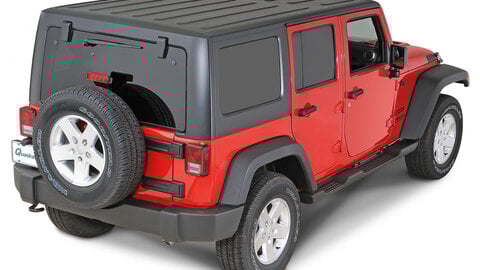
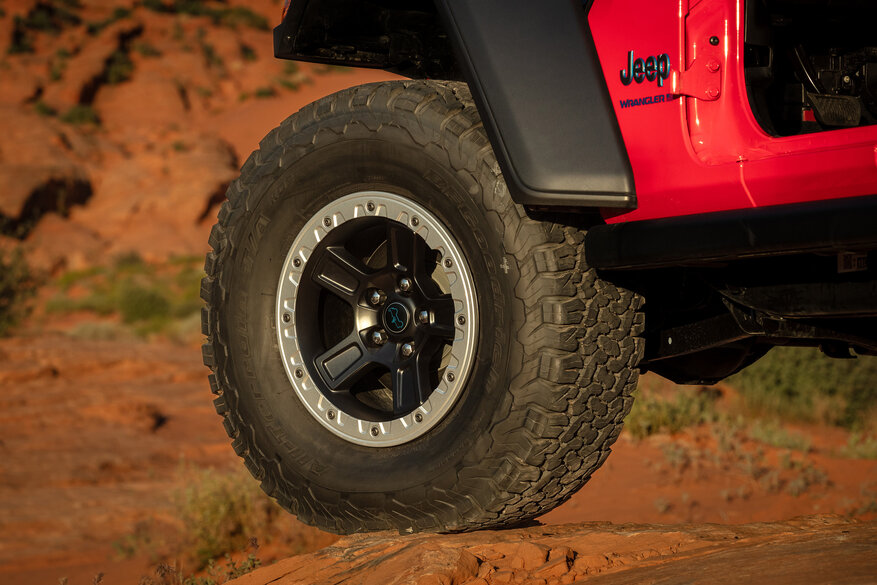
The Jeep Wrangler 4xe may look much like any other four-door Wrangler, but its plug-in hybrid powertrain changes what owners should consider when selecting replacement tires.
The 4xe combines a turbocharged 2.0-liter four-cylinder engine with two electric motors and a high-voltage battery pack. Together, the system produces 375 horsepower and 470 lb-ft of torque. And that output arrives quickly, giving the 4xe strong acceleration on pavement and excellent low-speed response on the trail.
However, that added power also places different demands on the vehicle’s tires.
The battery, motors, and supporting hybrid components also make the 4xe heavier than a comparable gasoline-powered Wrangler. For perspective, a Jeep Rubicon 4xe weighs about 5,165 pounds, compared with roughly 4,320 pounds for a non-hybrid Rubicon equipped with the 2.0-liter engine. That additional weight affects acceleration, braking, cornering, tire temperature, and tread wear.
None of this means the 4xe requires a special or unusually aggressive tire, but it does suggest owners should look beyond appearance and choose a tire that can properly support the vehicle while matching how it is driven.
Start with the Door-Jamb Tire Placard
The tire-information placard on the driver’s door jamb should be the starting point for any replacement-tire decision. It identifies the original tire size, recommended cold inflation pressure, and the vehicle’s seating and load information.
Replacement tires should have a load-carrying capacity equal to or greater than the original equipment tires. The easiest way to verify that capacity is to check the tire’s load index, which appears in the service description after the tire size.
For example, a tire marked 285/70R17 116T has a load index of 116 and a T speed rating. Owners should not install a tire with a lower load index unless the vehicle manufacturer or a qualified tire professional has approved the application.
Load Index and Load Range Are Not the Same Thing
Load index and load range are often treated as interchangeable, but they describe different tire characteristics.
Load index represents the amount of weight a tire can carry at a specified inflation pressure. This is the most important number when determining whether a tire has adequate capacity for a Wrangler 4xe.
Load range describes aspects of the tire’s construction and allowable inflation pressure. Passenger tires may carry Standard Load or Extra Load designations, while many light-truck tires are identified as Load Range C, D, or E.
An E-range tire is not automatically safer or better simply because it is rated for heavier service. Its stronger construction can be useful for towing, hauling, rocky trails, and resisting sidewall damage. However, it can also be heavier and stiffer than the 4xe requires.
That added tire weight may reduce ride comfort, acceleration, and electric driving efficiency. For owners who primarily commute and occasionally explore mild trails, an appropriately rated passenger or lighter LT tire may be the better overall choice.
Match the Tire to How You Use Your 4xe
The best 4xe tire depends less on the powertrain than on where the vehicle spends the majority of its time.
Mostly Pavement
A highway-terrain or mild all-terrain tire is generally the best fit for a daily-driven 4xe. These tires tend to offer lower road noise, predictable wet-weather braking, and less rolling resistance than aggressive off-road designs.
Lower rolling resistance is especially valuable on the 4xe because it helps preserve electric range and fuel economy. No tire will dramatically transform the vehicle’s efficiency, but a heavy mud-terrain tire can produce a noticeable penalty.
Daily Driving With Weekend Trail Use
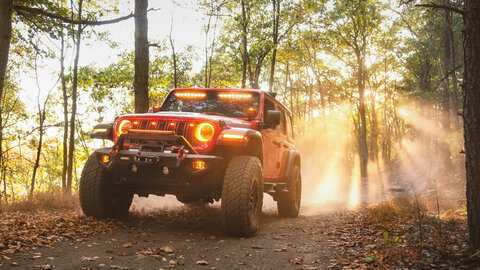
An all-terrain tire offers the most balanced solution for many Wrangler 4xe owners. It provides stronger tread blocks and improved loose-surface traction while remaining reasonably quiet and controlled on pavement.
The BFGoodrich All-Terrain T/A KO3, Falken Wildpeak A/T4W, and Nitto’s Recon Grappler A/T tires are examples of this category. The proper choice still depends on the exact size, load index, construction, and intended terrain.
Frequent Rock, Mud or Technical Trail Use
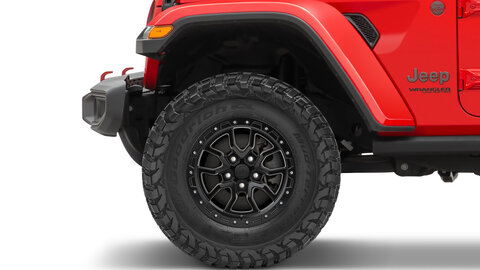
More aggressive all-terrain, hybrid-terrain and mud-terrain tires can provide better traction and stronger sidewalls in difficult trail conditions. The trade-offs include additional weight, more on-road noise, reduced wet-pavement refinement, and potentially lower electric range.
Owners should be honest about how frequently the Jeep encounters terrain that requires this level of tire. A mud-terrain tire may look appropriate on a Wrangler, but it is rarely the best-performing everyday tire for a vehicle that spends 90 percent of its time on pavement.
Snow and Ice
A Three-Peak Mountain Snowflake rating indicates that a tire meets an industry performance standard for acceleration traction in severe snow. It helps drivers who regularly encounter winter weather, but it does not make an all-terrain tire equivalent to a dedicated winter tire.
For frequent travel on packed snow and ice, a true winter tire will generally provide better cold-weather grip and braking because of its specialized rubber compound and siping.
Consider Tire Weight, Not Just Tire Size
Moving from a factory tire to a larger LT all-terrain or mud-terrain can add a substantial amount of rotating and unsprung weight at each corner. That affects electric range, as well as many other things.
Heavier tires can:
- Slow acceleration
- Increase braking distances
- Reduce steering response
- Make the suspension work harder
- Increase stress on steering and driveline components
- Reduce electric range and fuel economy
Two tires with the same advertised size can differ significantly in weight. Owners comparing tires should therefore examine the manufacturer’s published tire weight along with load index, tread depth and overall diameter.
For a 4xe that serves primarily as a daily driver, selecting the lightest properly rated tire that meets the intended use can preserve more of the vehicle’s factory ride and efficiency.
What Happens When You Install Larger Tires?
Larger tires can improve ground clearance and off-road capability, but the effects extend beyond creating enough room in the wheel openings.
A taller tire changes the vehicle’s effective gearing. This can reduce acceleration, alter transmission behavior, and make the drivetrain work harder. It may also make the speedometer and odometer inaccurate unless the vehicle is recalibrated for the new tire diameter.
Wheel width, offset and backspacing must also match the tire and vehicle. An improper combination can cause rubbing against suspension components, fender liners, or bodywork. Going substantially larger may require a lift, steering-stop adjustment, different wheels, revised axle gearing, or other supporting modifications.
The rear-mounted spare must be included in the plan as well. A full-size matching spare is important on a four-wheel-drive vehicle, and larger, heavier tire-and-wheel combinations may exceed the factory tailgate carrier's practical capacity.
Tire Pressure Still Comes From the Jeep, not the Tire Sidewall
The maximum pressure printed on a tire’s sidewall is not the recommended street pressure for the vehicle.
For factory-size tires, begin with the cold inflation pressure shown on the driver’s door-jamb placard. When switching to a substantially different size, construction or load range, the correct pressure may change because the new tire can carry the same load at a different pressure.
Simply inflating an E-range tire to its sidewall maximum can create an overly stiff ride, reduce the effective contact patch, and lead to irregular tread wear. A tire professional can calculate an appropriate starting pressure using the vehicle’s axle loads and the tire manufacturer’s load-and-inflation tables.
Owners should check pressure when the tires are cold and inspect them regularly. The 4xe’s additional weight makes proper inflation especially important for controlling heat buildup, maintaining predictable handling, and preventing premature shoulder wear.
Do EV-Specific Tires Matter?
A tire does not need an EV label to work on a Wrangler 4xe. Many conventional passenger and light-truck tires have sufficient capacity for the vehicle.
EV-oriented tires may include features intended to reduce rolling resistance, control road noise, or accommodate the weight and torque characteristics of electrified vehicles. Those qualities can help, but the EV designation should not take priority over load capacity, wet braking, terrain performance, durability, and proper fitment.
The best tire is the one that safely supports the vehicle and suits the owner’s actual driving, not necessarily the one carrying the newest marketing label.
Watch for Uneven Wear
Instant torque can accelerate tread wear when it is used aggressively, but it is only one part of the equation. Tire pressure, alignment, rotation frequency, suspension condition, and driving habits may have an even greater effect on tire life.
Rotate the tires according to Jeep’s maintenance guidance and use a five-tire rotation when the spare matches the four tires on the ground. A five-tire pattern distributes wear across the full set and helps keep the spare close to the overall diameter of the other tires.
Inspect the tread regularly for:
- Excessive wear along both shoulders, which may indicate underinflation
- Heavy center wear, which may indicate excessive pressure
- Feathering or one-sided wear, which may point to an alignment issue
- Cupping, which can suggest worn or ineffective suspension components
An alignment check is especially worthwhile after installing a lift, replacing steering or suspension parts, or repeatedly encountering hard trail impacts.
Final Thoughts
Choosing tires for a Wrangler 4xe is not simply a matter of buying the strongest load range available. The tire must first provide sufficient load capacity and fit the vehicle correctly. From there, owners should balance traction, construction, tire weight, road manners, winter performance, and off-road durability.
A properly rated all-terrain tire will be the best compromise for many 4xe owners. Drivers who spend nearly all their time on pavement may prefer a quieter, lighter, highway-oriented tire, while regular trail users may reasonably accept added weight and noise for stronger construction and more aggressive traction.
Start with the specifications on the door-jamb placard, match the tire to the way the Jeep is used, and consider the effects of size and weight before making the purchase. That approach will produce better results than choosing a tire based solely on appearance or load-range lettering.
Related Articles:
All-Terrain vs. Mud-Terrain Tires: Choosing the Right Tire for Your Adventure
How to Remove Ice and Snow From Your Jeep's Soft Top Windows