








by Matthew Konkle
Managing Editor
The red rocks surrounding Moab, Utah, seemingly radiate out forever into the desert. If Moab is the target, then the red rocks are its funnel, enticing off-road enthusiasts from around the world to converge at this ever-growing town in the southeastern part of the state.
And, while this is true for most of the year, it is especially accurate in the week or so leading up to Easter, when thousands of Jeep enthusiasts rally together in Moab for the annual Easter Jeep Safari.
This year’s edition marks 60 years for the event, and one of its highlights is the Jeep brand’s continuing desire to unveil concept vehicles tied to the event. These are one-off machines that the design department crafts, which normally feature modern and retro takes, incorporate current Mopar products and often include small ‘Easter egg’ hints of future vehicle details.
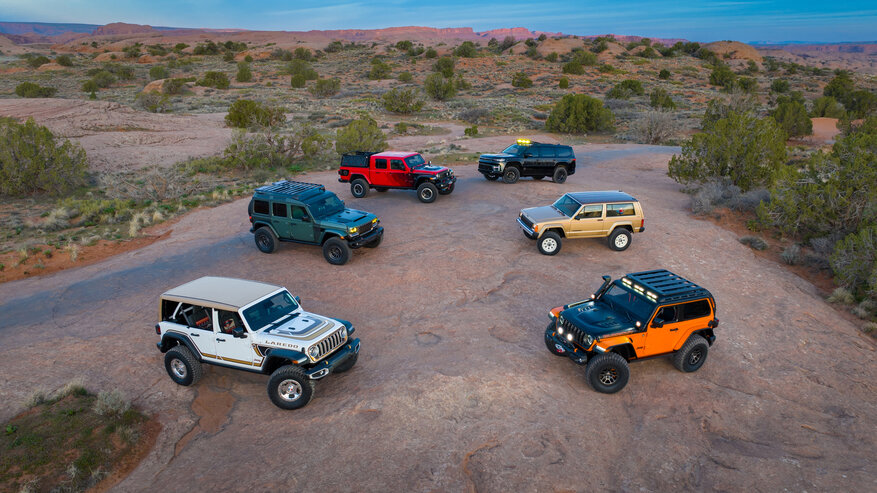
For the 2026 EJS, Jeep, on Thursday, rolled out its newest concept lineup that spans the full range of the brand, including three Wranglers; the Anvil 715, Laredo and Buzzcut, a Gladiator dubbed Red Rock, a 1984 Cherokee XJ Pioneer concept and the luxury Grand Wagoneer Commander.
“Moab isn’t just a place we visit. It’s a proving ground we honor and safeguard, a landscape we continually reinvest in and a community we’re proud to call our second home,” said Bob Broderdorf, CEO of the Jeep brand. “Easter Jeep Safari has shaped the Jeep brand for decades, fueling the evolution of our 4x4 vehicles and strengthening our bond with the community and the thousands of passionate Jeep enthusiasts who return year after year. To commemorate decades of off-road pioneering, we’re showcasing an exclusive lineup of Jeep concept and production vehicles, new immersive experiences and consumer activations, all to showcase the full depth of our off-road capability and reflect the core of who we are.”
EJS always gives Jeep designers a great canvas to show off creative builds, but this year’s editions seemingly lean closer to something that people could actually own, modify and take out on the trail. There isn’t a wild Crew Chief 715, or J6 two-door truck, that is a fantasy-type setup.
Instead, there is a purpose-built overlanding concept, buffed-up Gladiator, pristine XJ retromod, luxury/off-road showpiece, retro offering, and with Buzzcut serving as this year’s vehicle stuffed with parts from its Jeep Performance Products lineup.
“Partnering with the Jeep brand for our annual trip to the Easter Jeep Safari gives our Mopar designers and engineers a wonderful opportunity to put their latest ideas and innovations to the test on some of the toughest terrains we can find,” said Darren Bradshaw, senior vice president of Mopar North America. “Moab is the perfect place to meet Jeep owners, share what we’ve been working on, and showcase our expanding authentic and affiliate lineups of accessories that can help them elevate their vehicles and feel confident tackling any off-road adventure.”
With the brand’s next Wrangler overhaul (J70) scheduled for 2029, these concepts may also have a few Easter egg designs that will find their way into this new production vehicle.
Anvil 715 sets the tone
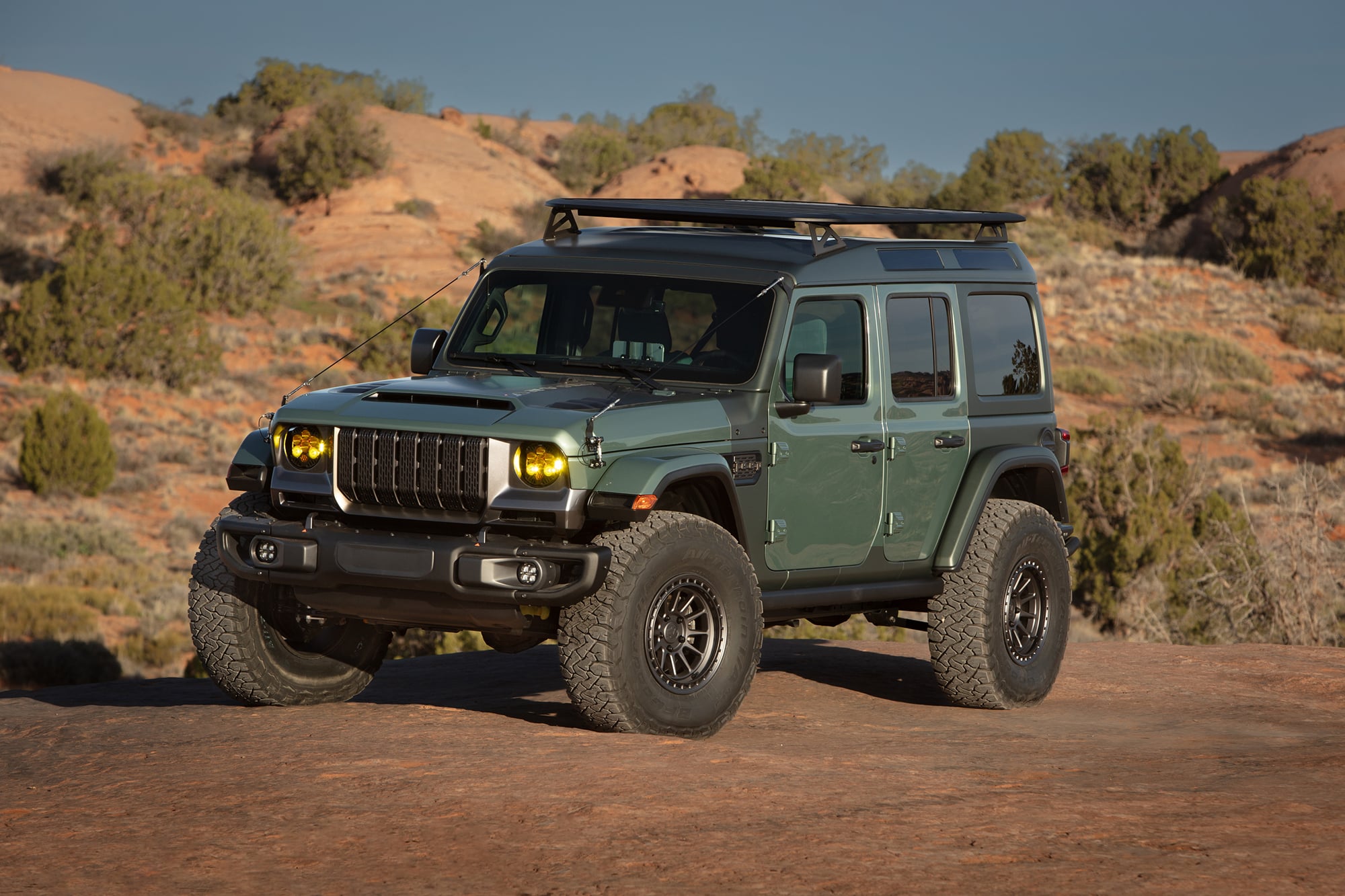
The Anvil 715 feels like the centerpiece of Jeep’s 2026 EJS lineup, and it’s easily the most engineered concept in the group. It will probably be the most talked about as well.
At a glance, it looks like a Wrangler with a military wrap. In reality, it is much more than that. Jeep’s design team used this build to push the Wrangler’s proportions in a way they normally wouldn’t.
Everything forward of the windshield has been reworked, and the front end is completely custom, inspired by the ‘rhino’ grille of the 1960s SJ-series vehicles. Instead of the traditional upright Wrangler face, the Anvil stretches outward. The nose sits roughly four inches farther forward than a standard Wrangler grille, giving it a longer, more purposeful stance. That extended, forward-leaning profile is exactly where the ‘Anvil” name is derived.
It also changes the vehicle’s presence in a subtle but important way. While modern Wranglers look compact and vertical, the Anvil looks planted and directional, like it’s built to move through terrain rather than just climb over things.
The roof is the other major departure. Jeep replaced the standard removable top with a fixed, raised roof structure that adds about four inches of headroom. It also integrates four skylights, which completely change the cabin feel. It’s brighter, more open, and clearly designed with long-distance travel in mind. The whole setup leans into a safari-style overlanding theme rather than a traditional rock crawler.
Underneath, designers stayed true to the Wrangler’s most extreme factory foundation. The concept is built on a Rubicon 392 platform, powered by a 6.4-liter V8 that delivers 470 horsepower. They paired this power with 37-inch BFGoodrich Mud-Terrain KM3 tires, 17-inch wheels, steel bumpers, and protective rock rails.
Lighting also plays a functional role here. The Anvil is equipped with both forward- and rear-facing auxiliary lights, designed for early trail runs and setting up camp after dark. It’s a small detail, but it reinforces the idea that this vehicle is meant to be used, not just displayed.
Inside, Jeep keeps the theme consistent. The cabin is finished in military-inspired green, and the traditional center infotainment screen has been replaced with a large, driver-oriented tablet running Trails Offroad mapping software. It’s a more focused, purpose-built setup that prioritizes navigation and trail awareness over typical in-vehicle tech.
What’s just as interesting is what Jeep chose not to include.
There’s no rooftop tent, no fully built-out overlanding kit, no excess clutter. That restraint appears to be intentional, with the design team treating the Anvil as a starting point rather than a finished build, leaving space for owners to imagine how they’d outfit it themselves.
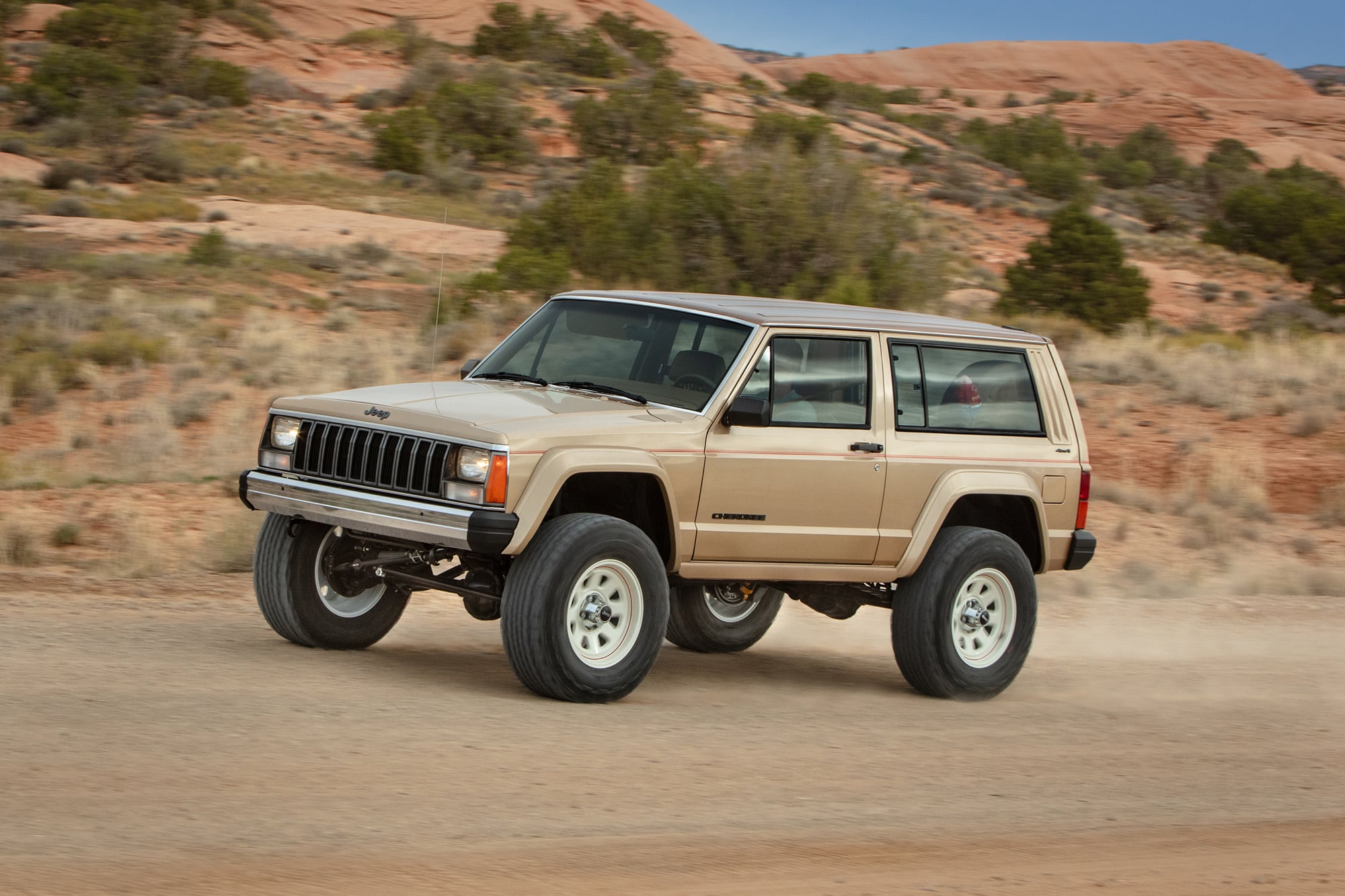
The Surprise Hit: Cherokee XJ Pioneer
Not every enthusiast is chasing the newest platform. Some are chasing the one they already love, just done right.
And that’s why the XJ Pioneer might be the most emotionally resonant vehicle in the entire lineup, because many enthusiasts attending EJS either owned a Cherokee or knew someone who did. Heck, they may even have one still. That’s exactly why this works.
Jeep said it found this one in Reno, Nevada, lovingly kept alive by an owner who documented every fuel fill-up over nearly four decades. By the time Jeep acquired it, the SUV had just 80,000 miles and was still in exceptional condition. A condition shaped the entire build.Most concepts involve tearing down a production vehicle and then reconstructing it. This one, though, was treated more with preservation than restoration by designers. The factory Champagne Gold Metallic paint remains, as well as the original 2.8-liter V6. Even the core character of the vehicle, how it looks, sounds, and drives, was left largely untouched.
The upgrades are there, but they’re deliberate. The suspension saw a modest 2-inch lift with ARB coil springs, paired with a disconnecting anti-roll bar to improve off-road articulation. It rides on 33-inch BFGoodrich All-Terrain KO2 tires mounted to 17-inch wheels that echo the original factory design. The fenders have been trimmed slightly and fitted with lightweight carbon-fiber flares, giving it a tougher stance without disrupting the original proportions.
Protection is subtle but functional. Custom rock rails have been added and finished in a matte, body-matched tone so they blend in rather than stand out. Overall, it is a trail-worthy XJ, and one that still looks like it belongs in 1986.
Inside is where the concept really leans into its identity. The cabin has been preserved almost entirely as-is, down to the period-correct dash, switchgear, and upholstery. Jeep didn’t try to modernize it. Instead, designers added small, era-specific details that feel personal rather than engineered.
Wood bead seat covers sit over the original Honey-colored bucket seats, a Rubik's Cube rests in the glove box area, and in the back, a Labyrinth lunchbox and a converted Apple Macintosh Plus case-turned-cooler complete the setup. None of it is necessary; all of it is intentional. Even the fact that a tachometer was once an optional add-on becomes interesting. This is a vehicle from a time when things just were built solid and Spartan.
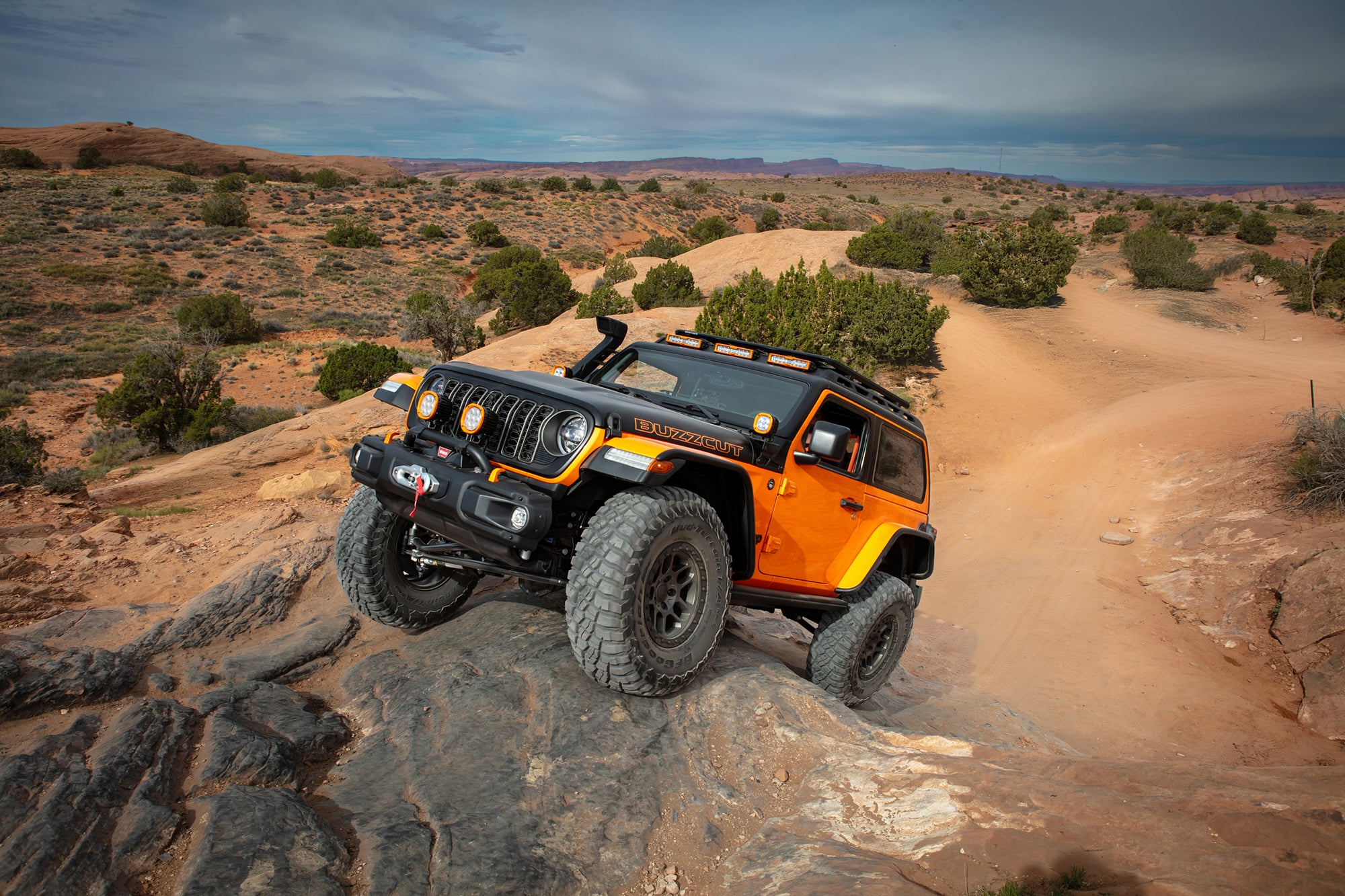
The Buzzcut is Mopar’s Rolling Product Catalog
If the Anvil is about rethinking form and the XJ is about remembering history, the Buzzcut is about something much more practical. This is Jeep showing exactly how far you can push a Wrangler using parts you can actually order.
Built by the Mopar team using Jeep Performance Parts, the Buzzcut started as a two-door Wrangler Rubicon, and then immediately changed appearance. The roof has been chopped by about two inches, the windshield laid back, and the rear glass angled to a fastback appearance. That alone gives it a completely different posture.
Even with a 2-inch lift and 37-inch tires, the Buzzcut looks lower, wider, and more planted. The stance is compact and aggressive, pretty much ready to take on everything.
The exterior leans heavily into that theme. Wide rock rails, steel bumpers, and high-clearance fender flares all come straight from the Jeep Performance Parts catalog. The bright Vitamin C metallic paint pushes it in the opposite direction visually, making sure it stands out as much as it performs.
But while previous iterations of Jeep concepts that sported JPP products, this one feels more like it has a purpose, and designers crafted the vehicle to carry gear for extended trips without losing usability.
The reworked hardtop integrates a rear grab handle, which pairs with an Amp Research fold-out step to access a Rhino-Rack Pioneer platform above. It’s a small but thoughtful detail that makes loading and accessing roof gear easier in real conditions.
In the back, the rear seats have been removed entirely. In their place is a lockable storage system that turns the cargo area into a secure, organized space for tools and equipment. It’s a practical solution that reflects how many owners actually modify their Jeeps.
Additionally, Buzzcut blends interior utility with a bit of unexpected comfort. The front seats are borrowed from a Dodge Charger and reupholstered in Katzkin leather and suede, giving the cabin a more supportive, performance-oriented feel without going over the top.
And then there’s the parts list. Nearly everything you see on Buzzcut is something you can purchase and add to your Jeep. These products include a tailgate table, an onboard air compressor, a cold-air intake, upgraded pedal covers, door sill guards, a fuel door, and floor mats. Even the intake feeding the turbocharged 2.0-liter engine is straight from JPP, along with powerful lighting from Tyri.
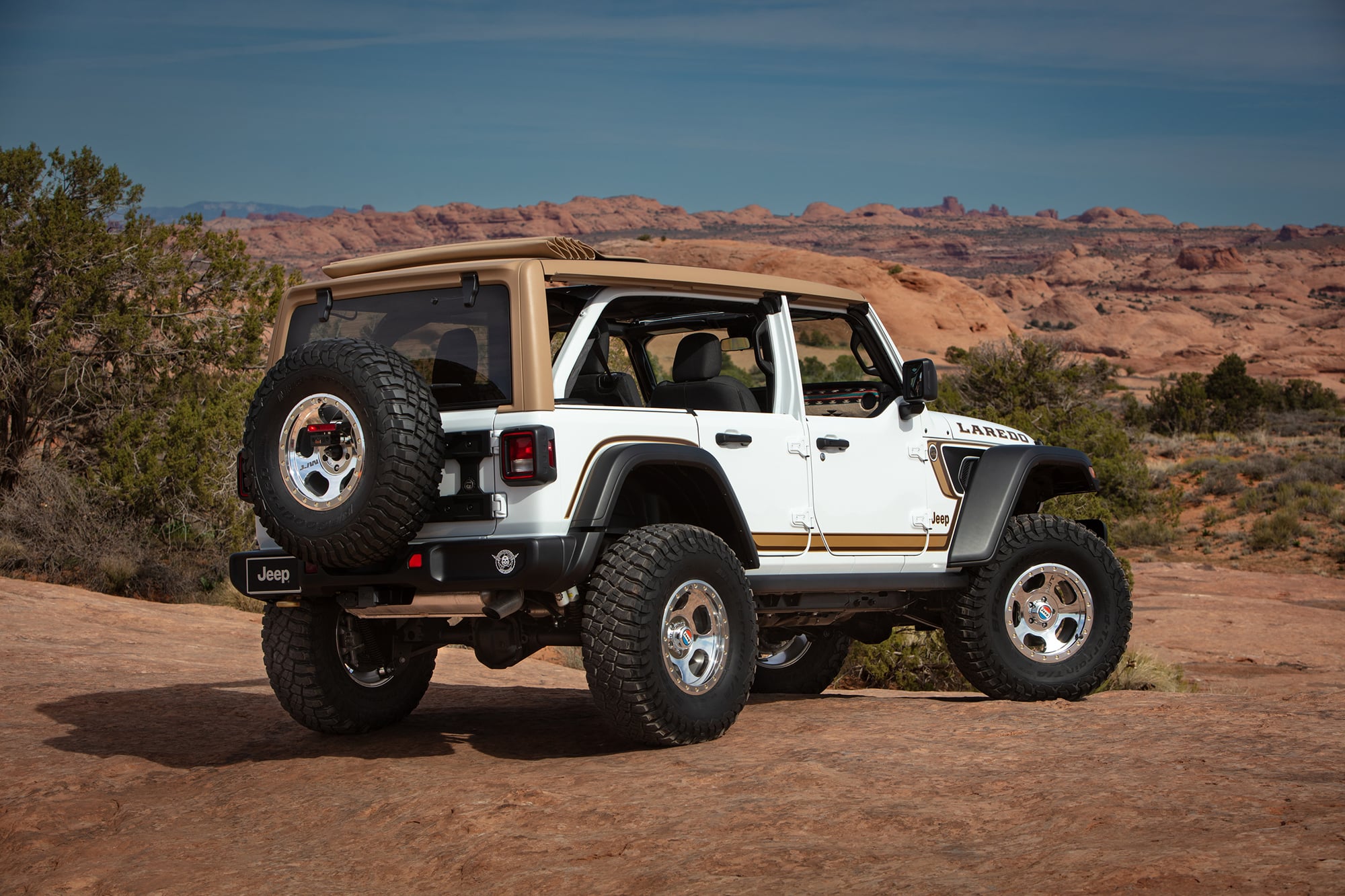
The Laredo: What made Jeep Appealing in the First Place
Jeep designers didn’t create the Laredo Concept to be extreme. It doesn’t chase overlanding trends or push radical design changes. Instead, it seems to ask a simpler question. What if you took a modern Wrangler and removed everything that doesn’t need to be there?
The idea comes straight from Jeep’s pre-Wrangler past, as the original Laredo trim in the 1980s added a touch of style to the CJ with chrome accents and subtle upgrades, while never losing the vehicle’s core simplicity. This modern concept follows that same philosophy, just translated to the current Wrangler JL.
It started life as a Wrangler Willys, which already leaned toward a more traditional, no-frills setup. Under the hood is a 3.6-liter Pentastar V6, paired with a six-speed manual transmission. That choice alone sets the tone, making this a driver-focused build instead of a tech-heavy one.
From there, the upgrades are straightforward and intentional. A Jeep Performance Parts 2-inch lift adds clearance without overcomplicating the suspension, while it rides on 17-inch retro-style slotted mag wheels, complete with CJ-inspired center caps, wrapped in 37-inch BFGoodrich tires. This makes for that old-school appearance, but with a fully modern capability.
The exterior, meanwhile, keeps things open and functional. Half doors, yes, Jeep JL half doors, and a hardtop with a sliding canvas section bring in fresh air and visibility. But Jeep deliberately removed the power operation from the sliding setup. You open and close it by hand.
That detail matters more than it seems. It reinforces the entire point of the build. This Laredo concept isn’t about convenience as much as it is about connection. It makes you interact rather than press a button and let something else do the work.
Inside, the floors are finished in durable vinyl for easy-to-clean, real-world use. The seats are upholstered in Southwestern-patterned fabric inspired by traditional horse blankets, a nod to the Laredo name and its roots. There’s no attempt to modernize the experience beyond what’s necessary. No oversized screens, no layered tech features competing for attention.
It’s something that reminds you Jeep’s appeal didn’t come from complexity, but from capability, simplicity, and the feeling that you could take it anywhere without overthinking the ride.
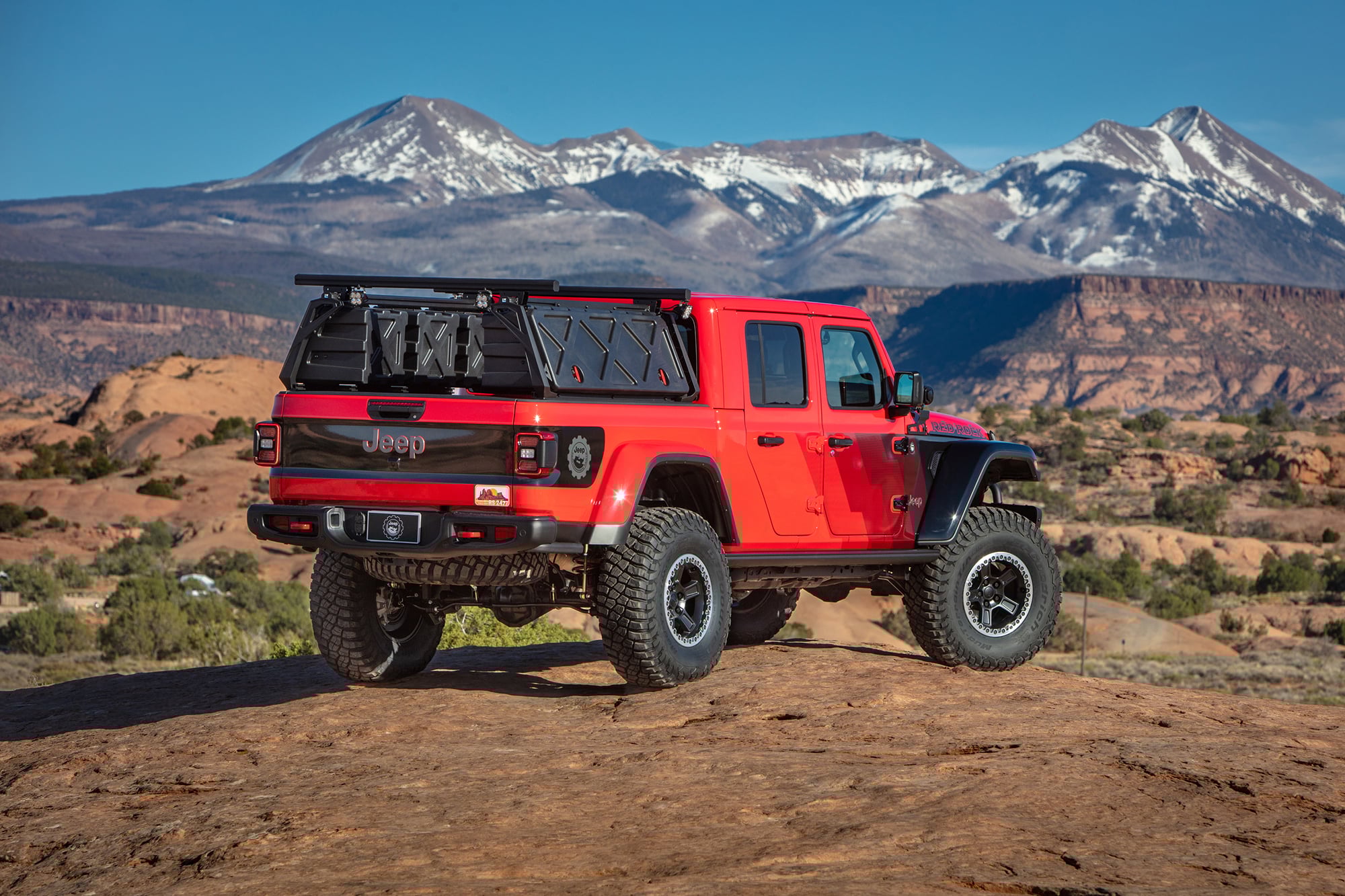
Red Rock, Built for the People Who Keep Moab Running
Nearly every EJS concept is created with the idea that it is to be seen once, then stored away somewhere back in a Michigan warehouse. From time to time, they see daylight at certain other shows around the country like Daytona, Florida’s Jeep Beach or Holly, Michigan’s Detroit Four Fest.
The Gladiator Red Rock is the opposite. It was crafted to stay in Moab and keep working throughout the year.
After next week’s Easter Jeep Safari wraps, Jeep will donate this truck to the Red Rock 4-Wheelers, the local club that has organized the event since 1982. That decision shapes everything about the build, making it less of a design exercise and more like a tool.
Every modification on Red Rock serves a purpose tied to trail maintenance, recovery work, and hauling equipment into remote areas.
The Gladiator platform is the right starting point, as its pickup bed allows for flexibility that a Wrangler can’t match. Out back, a Bedslide cargo tray makes it easier to access heavy tools, while a rack system with storage containers keeps equipment organized and secure.
Underneath, the Red Rock is set up to reach the same difficult terrain it will be tasked to maintain. A Rock Krawler Overland X Pro 3-inch lift kit increases clearance and articulation, while 37-inch BFGoodrich Mud-Terrain KM3 tires mounted on 17-inch beadlock wheels provide the grip needed to handle loose rock and steep climbs.
The supporting hardware is exactly what you’d expect from a vehicle that needs to be self-sufficient on the trail.
A steel front bumper houses a Warn winch for recovery situations, and strong rock rails protect the body in tight sections. TYRI auxiliary lights provide strong visibility during inclement weather or nighttime trail action, while an ARB air compressor allows quick tire pressure adjustments depending on the terrain, as well as the ability to power air tools.
Inside, the focus stays on durability and function. The cabin is fitted with Jeep Performance Parts accessory rails and grab handles, making it easier to mount gear and secure occupants on uneven ground. Traditional carpet has been replaced with Armorlite flooring, which is tougher, easier to clean, and better suited to mud, dust, and constant use.
Nothing here is decorative. This one fulfills a responsibility. It supports the people who build and maintain the very trails that make events like the Easter Jeep Safari possible.
And unlike the rest, it won’t disappear after the show. It’ll still be out there, doing the work.
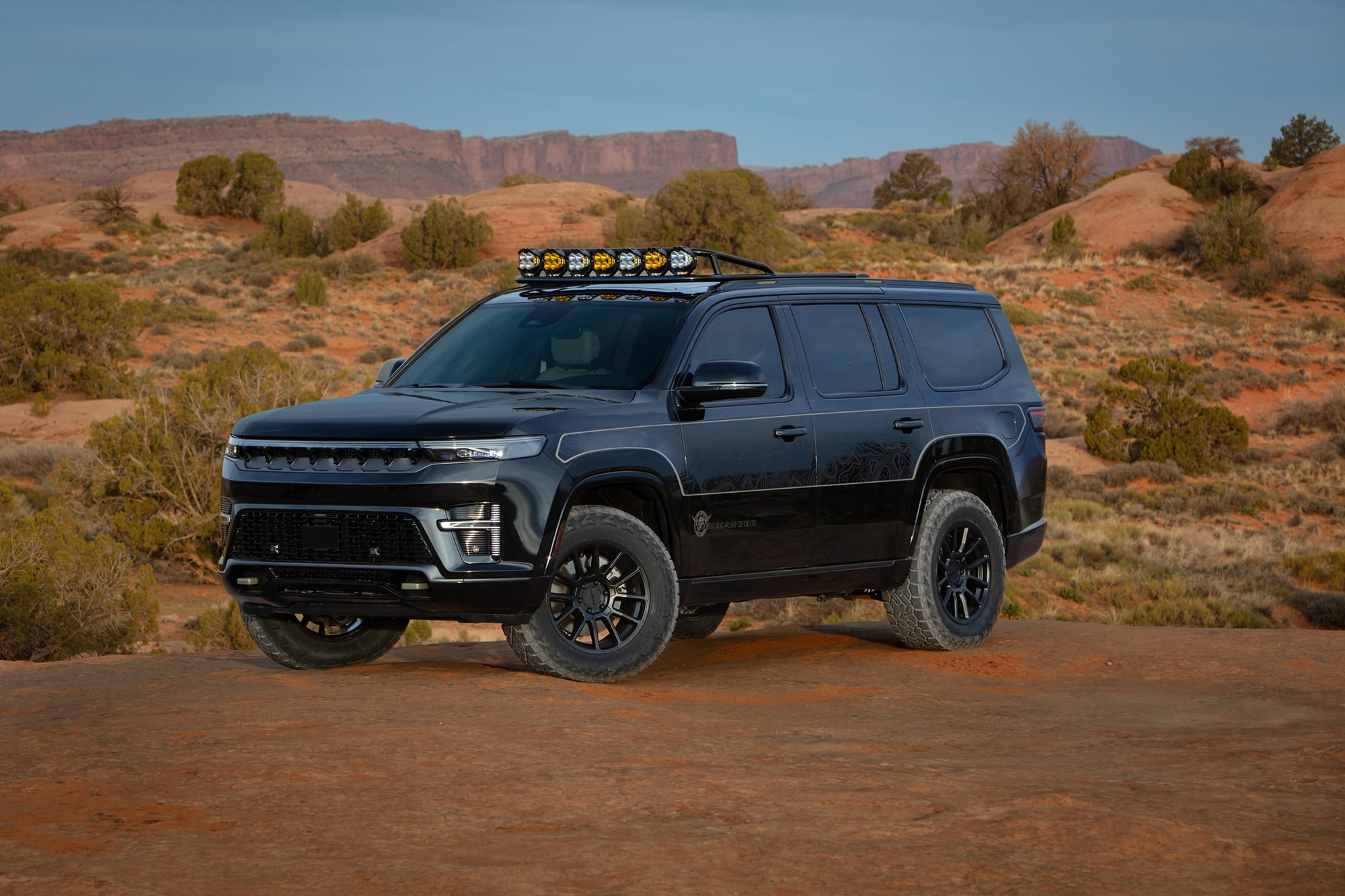
The Commander Redefines what a Full-Size Jeep can Do
The Grand Wagoneer isn’t supposed to be here. At least, not traditionally. Moab’s slickrock trails are mostly built for short wheelbases, tight breakover angles, and lightweight rigs. A three-row luxury SUV doesn’t naturally fit that environment.
But with this Commander concept, it appears Jeep wants to challenge this assumption.
This build reimagines the Grand Wagoneer as something more than a highway cruiser. No, the idea isn’t to turn it into a dedicated rock crawler; it is to create a vehicle that can perhaps tow your trail rig into the desert beyond Moab, then confidently explore once it gets there.
To start, Rock Krawler reworked the suspension and tuned it more for off-pavement action, slightly lifting it to increase ground clearance and improve approach and departure angles. It rides on 20-inch wheels wrapped in 35-inch Nitto Recon Grappler all-terrain tires, a combination that balances off-road traction with on-road stability.
Protection comes next, and custom skid plates have been added underneath to shield critical components, a necessary upgrade for a vehicle of this size and weight. Up top, a custom roof rack carries a bank of seven Baja Designs lights controlled through an sPOD system, giving the Commander serious forward visibility for low-light trail driving.
Visually, Jeep ties the concept back to its heritage in a more subtle way. Instead of traditional faux-wood paneling, the Commander features body-side graphics inspired by topographic maps of Canyonlands National Park. The pattern even extends across the panoramic glass roof, giving the concept a distinct identity without leaning too heavily on retro cues.
Inside, it remains unmistakably Grand Wagoneer. Jeep didn’t strip out the luxury or try to make it feel utilitarian. The Commander retains its premium materials, space, and comfort while adding capabilities around it. It’s meant to show that off-road readiness and refinement don’t have to cancel each other out.
Related Jeep Guides, Tips & Trail Advice:
The New Jeep Owner’s Handbook: What You Need to Know From Day One