














by Quadratec
There’s a moment when you realize something has changed, you just can’t quite point to it yet. Nothing looks dramatically different on the surface, the lineup still feels familiar, and the options are still there. But underneath it all, the direction has shifted.
That’s where Jeep is right now.
In the years since Jeep unveiled its latest Wrangler, it has leaned on a mix of proven powerplants: the dependable Pentastar V6 for some, the efficient 2.0L turbo for others. For a while, there was also a 3.0L EcoDiesel option for those who wanted more torque, as well as a 6.4L Hemi dubbed the 392 for power lovers.
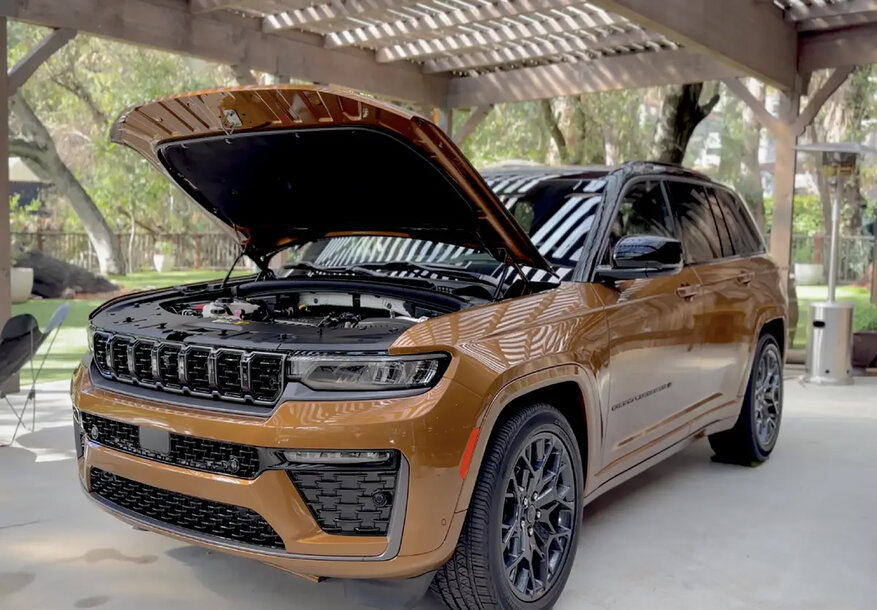
Then, Stellantis engineers created something new: a 2.0L Hurricane 4 engine that, at least initially, will appear in the 2026 Grand Cherokee.
It's an engine that doesn’t just fit into the brand's lineup; it quietly outperforms it. The Hurricane delivers more power and torque than the Pentastar or turbo four, with that torque showing up exactly where Jeep drivers actually use it.
That’s when the question changes.
Not whether the Hurricane belongs in a Wrangler, but will Jeep actually put one inside the vehicle?
Not Entirely New, But New-Ish
'Hurricane' doesn’t describe a single engine so much as an entirely modern modular architecture.
The name itself has been around for a while, with its recent iteration appearing in the Ram 1500, Wagoneer, and Grand Wagoneer over the past few years. Its 3.0‑liter twin‑turbo inline‑six platform is offered in standard‑output and high‑output forms, producing roughly 420 horsepower and up to 510 horsepower, respectively. Perhaps its best feature is delivering stronger performance with significantly lower fuel consumption and emissions.
But with Jeep's newest Grand Cherokee on the horizon, engineers decided to construct a different Hurricane powerplant, this one a 2.0‑liter Hurricane 4 Turbo. This engine rewrites expectations for what a modern four‑cylinder can deliver, pushing 324 horsepower at 6,000 rpm and 332 lb‑ft of torque over a broad midrange. That places it among the most powerful production fours ever sold, regardless of segment.
What ties both engines together is philosophy. Aluminum construction to reduce mass, forged rotating assemblies for durability under sustained boost, and turbochargers tuned for low inertia and fast response. This one is designed to work hard at low and mid rpm, exactly where Jeep vehicles operate most often.
Inside the Hurricane: Modern Combustion Done Properly
The most meaningful leap forward is how Hurricane engines make power.
The Hurricane 4 Turbo is one of the first mass-produced engines to employ passive turbulent jet ignition (TJI), a combustion system derived from top-tier motorsport. Instead of igniting the air‑fuel mixture solely from a conventional spark plug, the cylinder uses a small pre‑chamber. When ignited, it fires high‑energy flame jets into the main combustion chamber, accelerating flame propagation and ensuring a more complete burn.
That allows the engine to safely run a 12:1 compression ratio, exceptionally high for a turbocharged gasoline engine, and also without detonation, even on regular fuel.
Supporting that system is a dual injection strategy, blending port injection and high‑pressure direct injection (up to 350 bar). At low loads, port injection minimizes noise and particulate emissions. Under boost, direct injection takes over to control combustion temperature and knock. During cold starts, both systems work together to speed catalyst warm‑up.
The older inline‑six Hurricane follows a different tuning path, focusing on refinement and torque density rather than outright specific output, but the principle is the same: controlling combustion precisely instead of overpowering inefficiencies.
Turbocharging with Intent
Turbocharging has become increasingly complex over the years, but it remains highly functional.
Both Hurricane engines rely on single turbochargers optimized for fast spool and consistent response, rather than chasing extreme peak boost. In the case of the Hurricane 4, a variable‑geometry turbocharger actively adjusts vane angles to maintain boost and torque across a wide rpm band, delivering up to 35 psi when conditions demand it.
The result is a torque that arrives early in the rpm range, right where crawling, towing, and passing actually happen. And all without the lag traditionally associated with high-output turbo fours. This is especially important for Jeep, where low-speed drivability matters far more than top‑end power.
Built for Stress, Not Just Specs
Durability is a central part of the Hurricane story.
Both engines use deep-skirt aluminum blocks with ladder-frame reinforcement for rigidity. Additionally, forged-steel crankshafts and robust piston-cooling systems are designed to endure sustained loads, not just short bursts of power. Integrated exhaust manifolds help reduce warm-up times and improve thermal efficiency, though they also introduce heat-management challenges that Jeep engineers have been methodical in addressing.
The inline‑six, in particular, benefits from its natural balance. With fewer harmonic compromises than a V6, it delivers smoother operation under load, something that matters in large SUVs tasked with towing and long-distance travel.
Why Jeep Needed This Engine
The Hurricane exists because Jeep needed an engine strategy that wasn’t fighting real-world scenarios.
Global emissions standards are tightening. Customers still expect performance. Electrification is expanding, but internal combustion isn’t disappearing overnight. So Jeep needed an engine family that could bridge that gap while remaining scalable, compliant, and unmistakably capable.
Instead of maintaining multiple overlapping engines, each tailored to a specific niche, the Hurricane gives Jeep a single, modular internal-combustion foundation. Inline‑six for size, smoothness, and torque. Turbo four for efficiency, compact packaging, and high power density. The brand says both engines are designed to integrate cleanly with future hybrid systems.
The Wrangler Problem is All About Physics
All this brings us to the inevitable question: why hasn’t Hurricane made its way into the Wrangler?
The answer has very little to do with output. Wrangler duty cycles are brutal and can include long periods at low speed, extreme angles, limited airflow, and high ambient heat. Turbocharged engines concentrate thermal loads in ways naturally aspirated engines never did, and managing that heat when crawling over rocks is far more difficult than doing it at highway speed.
The inline‑six also adds length, while the turbo four adds heat density. Neither issue is insurmountable, but in a Wrangler, tolerances are thinner, and consequences are higher.
On Paper, It Makes Perfect Sense
From a performance standpoint, the Hurricane is an obvious fit. Even the Hurricane 4 would easily surpass either the Wrangler's Pentastar V6 or the 2.0L turbo four. The six-cylinder high‑output Hurricane version would sit squarely in Wrangler 392 territory, offering comparable acceleration and torque with less mass over the front axle and a dramatically more future-proof design.
That last point matters because the 392 is catnip to Wrangler enthusiasts who love power, but it’s also expensive, thirsty, and increasingly difficult to justify long-term. A Hurricane option, if achievable, would preserve that performance identity without simply relying on displacement.
Timing, Strategy, and the Long Game
For now, the obstacles are practical. Things like cooling complexity, cost, and product positioning. Jeep’s current focus keeps the Wrangler centered on forced induction, so any new internal-combustion option has to complement, not complicate, that direction.
As far as implementation into a Wrangler, well, history would suggest patience. Jeep seems to always introduce major powertrain shifts in larger vehicles first, then adapt them once engineering lessons are learned. The Hurricane rollout follows that exact pattern. If and when it reaches the Wrangler, it could be a higher-end option and not a mass replacement.
Related Jeep Guides, Tips & Trail Advice:
The New Jeep Owner’s Handbook: What You Need to Know From Day One
Easter Jeep Safari 2026: Jeep’s Moab Concepts Turn Into Real-World Adventure Builds