



by Ricky Seace
Quadratec Channel Staff Writer
The transfer case design on YJ and TJ Wrangler vehicles, as well as XJ Cherokees, holds up well for street driving and light off-roading, but once you have added a lift kit and larger tires to the Jeep, all that additional stress can cause problems.
Specifically, problems with the slip yoke – or rear output shaft.
Normally, the slip yoke in these vehicles functions to transfer power from the transfer case to the fixed rear drive shaft. Because it is able to slide in and out of the transfer case, the slip yoke can change driveline length even though that drive shaft is fixed. However, once the Jeep is lifted it changes the driveline angle beyond what the slip yoke can cover. This will cause excessive driveline vibrations, or worse, the slip yoke can actually slide out of the transfer case.
With smaller lift kits, it is possible to avoid this problem by using transfer case drop brackets. Still, many lift kit companies strongly recommend installing a slip yoke eliminator along with a CV (constant velocity) drive shaft when adding a lift kit above 2”. This is actually required for 4” or higher lifts.
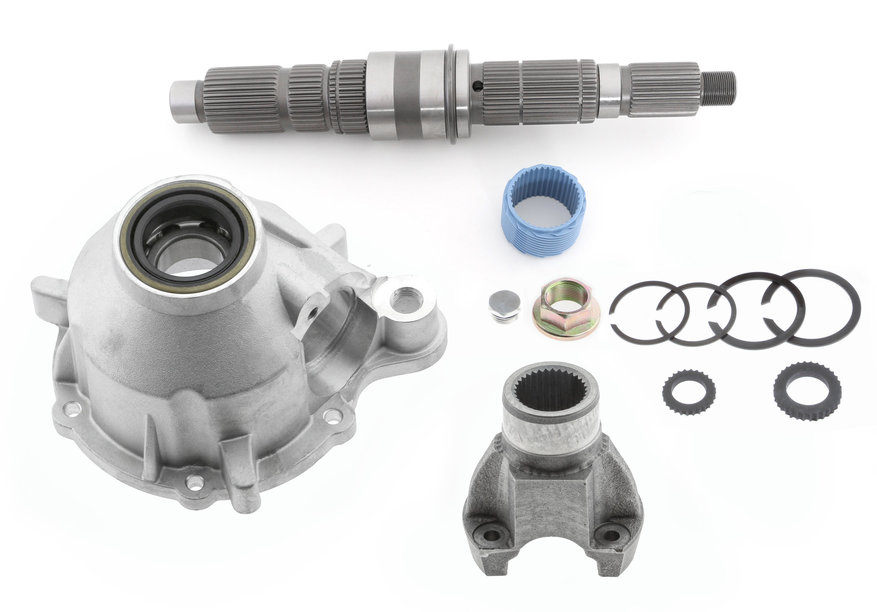
A Jeep slip yoke eliminator, no surprise here, is a kit that eliminates the transfer case slip yoke and adds a fixed flange or yoke instead. This allows for removal of the factory fixed drive shaft and installation of a CV (constant velocity) driveshaft in its place.
Having this CV driveshaft gives you two u-joints instead of just the factory one, and it also eliminates driveline vibration because the shaft now turns at a constant speed. Plus, the aftermarket CV driveshaft can operate at a more severe angle, which is perfect for a lifted vehicle. Another benefit of an SYE kit is that it seals the tail shaft at the back of the transfer case, meaning it will not leak fluid if the drive shaft is removed.
Slip Yoke Eliminator kits consist of a shorter output shaft, new speedometer ring, output yoke and nut, snap rings, front and rear output seals and a new shorter output case. Also, like we said before, you will need that aftermarket CV driveshaft as well since you are shortening the output shaft.
So if your Jeep lift kit plans involve getting that YJ, TJ or XJ up in the air 2” or more, you should definitely invest in an SYE kit and an aftermarket CV driveshaft. Not only will this allow for more ground clearance, but it also helps eliminate driveline vibrations and will keep the driveshaft from pulling away from the transfer case.